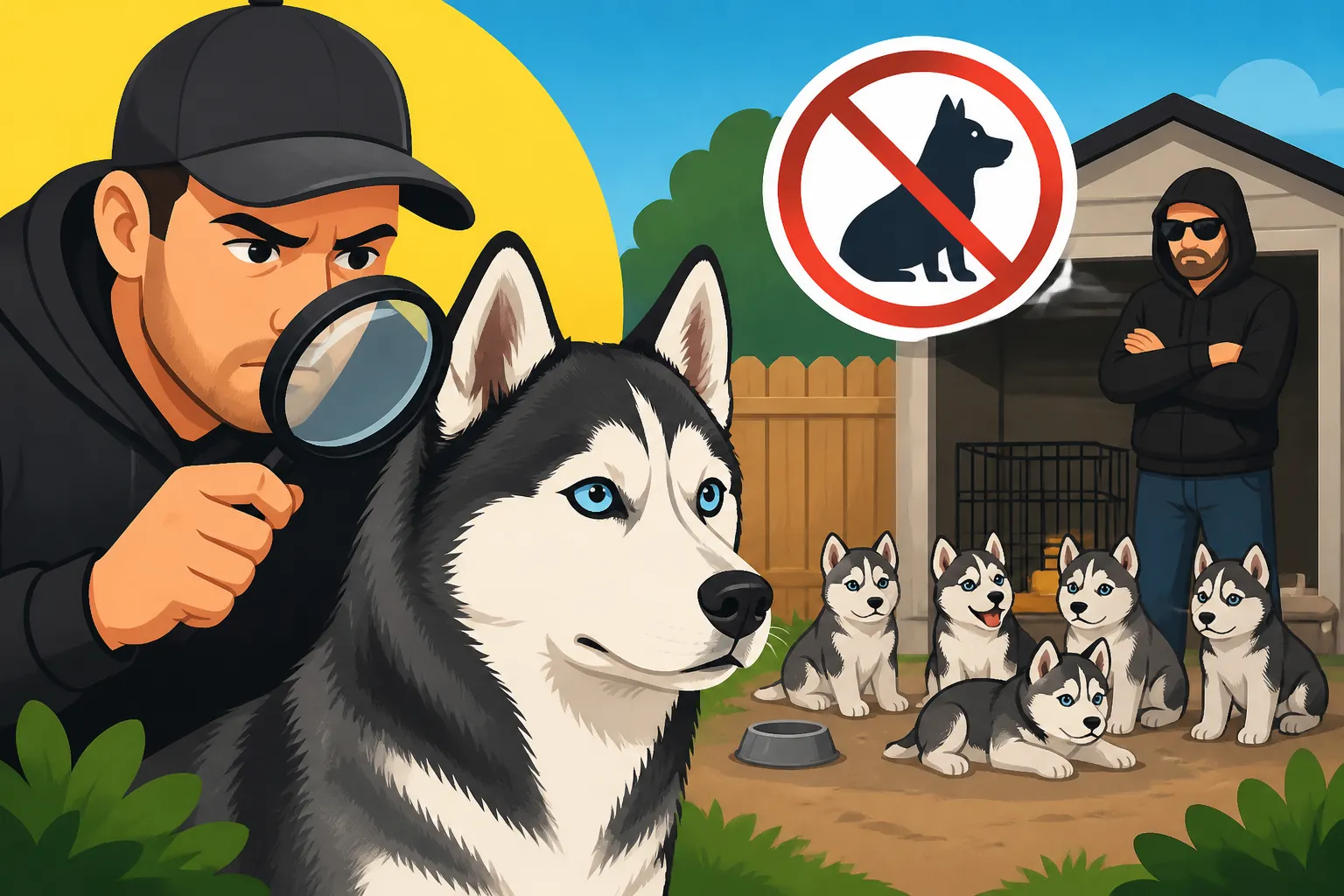
Spotting a Backyard Siberian Husky Breeder
A Siberian Husky puppy can look healthy, confident, and well cared for during a short visit, while important questions about its parents, health screening, and early socialization go unanswered. That uncertainty makes it hard to tell a responsible breeder from someone breeding casually for quick sales. This guide explains what to check, what to ask, and when to step away without making a snap judgment.
What backyard Siberian Husky breeding can look like
“Backyard breeder” is a common label, not a formal certification. It usually describes someone breeding dogs without the planning, health screening, transparency, or lifelong responsibility expected from a reputable breeder. A puppy being raised in a home does not automatically make the breeder responsible—or irresponsible. Focus on what the seller can show and explain.
Warning signs that deserve a closer look
Be cautious if the seller has puppies available all the time, advertises several litters at once, or seems to choose breeding dogs mainly for coat color or blue eyes. Those details do not prove neglect by themselves, but they matter when paired with a lack of health records or a seller who cannot explain why the particular parents were bred.
Other concerns include refusing to let you see where the puppies are raised, offering to meet only in a parking lot, or pushing for a deposit before answering basic questions. A seller may have reasonable limits around visits to protect young puppies from illness, but should still explain the situation and offer another credible way to show you the mother, the living environment, and the puppies’ daily care.
Pay attention to whether the seller asks you questions, too. A responsible breeder generally wants to know about your household, schedule, experience with active dogs, and plans for exercise and containment. If the conversation is only about payment and pickup, or if you are told that a Husky is an easy fit for any home, slow down. For a broader look at the commitment involved, read Who Should and Should Not Own a Siberian Husky.
A home setting is not proof of responsible breeding
A clean kitchen, attractive website, or affectionate mother dog can make a reassuring first impression. Those things matter, but they are only a small part of the picture. The more useful questions are whether the breeder has made thoughtful choices about the parents, can document health screening, and has a plan for each puppy if a placement does not work out.
Likewise, a small-scale breeder is not automatically a backyard breeder. Some responsible breeders raise a limited number of litters and keep puppies in a home environment. What separates careful breeding from casual breeding is the work behind the litter: choosing suitable parents, providing veterinary care, keeping records, helping puppies develop, and staying available to owners after they go home.
The label itself is less useful than evidence. Ask to see the relevant records, talk through the breeder’s decisions, and notice whether answers are specific and consistent. If you are weighing a breeder against adoption, Choosing Between a Siberian Husky Breeder and a Rescue can help you think through both paths.
How to check health claims and paperwork
A seller may say that the parents are “healthy,” “vet checked,” or “genetically clear.” Those phrases can mean different things. A routine veterinary exam is not the same as breed-relevant screening, and a DNA test for one condition does not cover every inherited health concern.
Ask what was tested and verify the results
Ask for the registered names of both parents and copies of their health results. Find out which tests were performed, when they were completed, and which organization recorded them. Then check that the names on the paperwork match the dogs being discussed. If the seller says records are available online, ask where to find them rather than relying on a screenshot or a verbal summary.
For Siberian Huskies, buyers commonly look for documented hip evaluations and eye examinations by an appropriate veterinary eye specialist, alongside other testing recommended by breed-health resources. Testing recommendations can change, so confirm what is relevant for the dogs in front of you. Health Testing Before You Buy a Siberian Husky explains the purpose of screening, while What a Siberian Husky Breeder Should Hand Over covers the records and information a buyer should expect to receive.
| Seller’s claim | What to ask for | Why it matters |
|---|---|---|
| “The parents are healthy” | Specific screening results and veterinary records | A general statement does not show which conditions were assessed |
| “They are genetically clear” | The exact test, result, and tested dog’s identity | A result applies to particular conditions, not every possible health issue |
| “The puppies had a vet check” | The puppy’s exam record and any follow-up instructions | A puppy exam is useful but does not replace screening the parents |
| “The dogs are registered” | Registration details and the parents’ full registered names | Registration documents identify ancestry but do not prove responsible breeding |
| “The breeder guarantees the puppy” | The written terms, exclusions, and what the buyer must do | A guarantee can vary widely and should be understood before payment |
If the seller uses a health-testing term you do not recognize, ask them to explain it and show the record. You can also compare their claims against Whether a Husky Breeder's Testing Claim Checks Out. A careful breeder should welcome reasonable verification rather than treating it as an insult.
Understand what paperwork can and cannot prove
Registration papers may document a dog’s recorded ancestry, but they are not a certificate of health, temperament, or breeding quality. Similarly, a puppy’s vaccination record is important, but it does not demonstrate that its parents received appropriate screening. Keep these documents in their proper lanes instead of treating one impressive-looking paper as proof of everything.
Read any contract before paying a deposit. Look for the seller’s contact information, the puppy’s identifying details, health disclosures, and a clear explanation of what happens if a serious concern emerges. Ask what support is offered if you cannot keep the dog later. A responsible breeder should care where the puppy ends up, not simply complete the sale.
If a breeder makes a sweeping promise—such as guaranteeing that a puppy will never develop a health problem—ask what that promise means in writing. No breeder can control every future illness or injury. A thoughtful contract can set expectations, but it cannot replace careful breeding, veterinary care, or the owner’s responsibilities.
What to look for when you meet the breeder
A visit is an opportunity to observe, not just to admire puppies. You are looking for signs that the dogs are cared for, the breeder knows the litter well, and the explanations match what you can see. If an in-person visit is not possible for a reasonable reason, ask for a live video call or another way to see the mother and puppies in their everyday setting.
Observe the mother and puppy environment
When possible, meet the mother with her puppies. Notice whether she appears comfortable with the breeder and whether she can rest away from the litter. A mother may be tired or protective, so do not expect a polished greeting. Instead, look for an overall picture of care: clean water, a safe resting area, and puppies who have room to move and interact.
Ask where the puppies spend their time and what everyday experiences they have had. They should receive age-appropriate handling and exposure to normal household sounds without being overwhelmed. A seller who talks about socialization should be able to describe what that means in practice, rather than using it as a vague selling point.
Puppies can be energetic, sleepy, noisy, or shy during a visit. One brief interaction cannot predict an adult dog’s personality. Ask how the breeder describes each puppy and what observations they used to make that assessment. For advice on meeting the parent dogs and interpreting the interaction, see Meeting a Siberian Husky Litter's Parents.
Ask questions that reveal the breeder’s approach
The way a person answers can be as revealing as the answer itself. A responsible breeder should be able to discuss the parents’ temperaments, why they were paired, the puppies’ care, and the challenges of living with a Siberian Husky. They should be willing to say that a particular puppy may not suit your circumstances.
Useful questions include:
- What health screenings have the parents completed, and can I see the results?
- Why did you choose these two dogs for this litter?
- What are the parents like around people, other dogs, and everyday household activity?
- How are the puppies being socialized, and what veterinary care have they received?
- What support do you offer after the puppy goes home?
- If I can no longer keep the dog, what would you want me to do?
- How do you decide which puppy is a good match for each home?
Listen for concrete examples rather than rehearsed assurances. “We work on calm handling and introduce ordinary home sounds gradually” tells you more than “They’re very well socialized.” A seller who becomes hostile over polite questions, refuses to provide relevant records, or pressures you to commit immediately is giving you useful information—even if the puppies seem appealing.
How to decide whether to proceed
It is easy to feel rushed when a litter is available and you have already pictured a puppy at home. That excitement is real, but it can make warning signs easier to excuse. Give yourself time to compare what the breeder says with the documents, the dogs’ condition, and your own observations.
Sort concerns from deal-breakers
One imperfect detail does not automatically mean a breeder is irresponsible. For instance, a breeder may limit visitors while puppies are very young, or may not have every document ready during an initial conversation. The important part is whether the explanation is reasonable and whether the seller follows through with verifiable information.
By contrast, missing health records combined with pressure to pay, no access to credible information about the mother, and no clear plan for a returned dog form a much more troubling pattern. Treat several independent red flags as more significant than a single awkward moment. If something feels off, pause and ask a trusted veterinarian or experienced breed-club contact to review the information with you.
Do not send money simply to “hold” a puppy while important questions remain unanswered. If you have already paid a deposit, review the written terms and keep all communication and payment records. Avoid escalating a disagreement at the breeder’s home; you can leave, document what happened, and seek appropriate local consumer or animal-welfare guidance if necessary.
Prepare for the puppy without being pushed into extras
A seller may recommend a particular food, crate, or grooming tool. Ask for the exact food name and feeding routine so you can avoid an abrupt diet change during the transition. You can discuss any planned change with your veterinarian. Retailers such as Chewy may help you compare basic supplies or locate product information, but product listings do not replace veterinary guidance about a puppy’s diet or health needs.
Be wary if buying a bundle from the breeder is presented as a condition of getting the puppy, especially if the seller will not explain what is included or provide clear product details. You can source ordinary supplies independently. For example, Chewy is one place owners may browse for grooming basics, but the important part is choosing tools suitable for a Siberian Husky’s double coat and learning how to use them gently.
A puppy should leave with clear records and care instructions, not just a bag of supplies. Ask what food the puppy currently eats, what veterinary visits have taken place, and what follow-up care is recommended. If you use Chewy or another retailer to order the same food after pickup, double-check the formula and packaging so you do not accidentally switch to a different product.
The best decision is not always “buy” or “walk away” in the moment. It may be to request records, verify the parents’ screening, talk to your veterinarian, or look at another litter. A breeder who is genuinely invested in the puppies’ welfare should understand why you need confidence before making a long-term commitment. When the answers remain vague or the pressure keeps building, it is reasonable to leave and continue your search.
Disclaimer
This article is for general informational purposes only and does not constitute professional advice. Laws, prices and regulations vary by location and change over time. Consult a qualified professional for guidance on your specific situation.