Coyote Rollers on a Siberian Husky Fence
Oh, the sheer frustration of looking out into your yard only to find your Siberian Husky has, yet again, defied gravity or logic and made a break for it! It's a common story for us husky owners, isn't it? We build fences, we reinforce them, and yet our clever, agile, and endlessly curious dogs often see these barriers as nothing more than a fun puzzle to solve. If you're tired of frantic searches and the constant worry of an escaped husky, you've likely started researching every possible solution, and that's probably how you landed on the idea of coyote rollers. This guide is here to break down what coyote rollers are, how they work specifically for a Siberian Husky, and whether they might be the answer to your Houdini hound's escape artistry.
Understanding the Siberian Husky Escape Artist
Let's be real, owning a Siberian Husky means signing up for a life of constant vigilance when it comes to containment. They're not just dogs; they're intelligent, athletic, and often highly independent thinkers with an innate drive to explore. This isn't a flaw in their character; it's deeply ingrained in their heritage, making them fantastic working dogs but also champion escape artists.
Why Your Husky Sees a Fence as a Challenge, Not a Barrier
For many breeds, a fence is a clear boundary. For a Siberian Husky, it's often more of a suggestion, or perhaps even an obstacle course. Their intelligence is a double-edged sword; it allows them to learn commands quickly, but it also enables them to analyze and exploit weaknesses in your containment. They'll test every slat, every gate latch, every loose post. A husky’s ancestral need to roam, to cover vast distances, and to follow scent trails is still very much alive, even in a suburban backyard. This isn't boredom in the way a couch potato dog gets bored; it's a deep-seated instinct to move and explore. If they perceive an opportunity, they will absolutely take it. It’s part of their charm, but also a huge source of stress for owners.
Think about it from their perspective. They see a squirrel on the other side, or they catch a whiff of an interesting scent carried on the breeze, and their brain immediately calculates the most efficient way to get to it. That fence isn't a permanent fixture; it's a temporary inconvenience to be bypassed. This drive is why many husky owners understand the importance of comprehensive health testing before you buy a Siberian Husky, as escaping often leads to trauma and injury.
Common Husky Escape Tactics Beyond Digging
While we often hear about huskies being champion diggers—and they certainly are—their escape repertoire extends far beyond excavating under a fence. Many a husky owner has stood dumbfounded, watching their dog scale what they thought was an impenetrable barrier. Siberian Huskies possess incredible agility and powerful hind legs, allowing them to jump surprisingly high. A standard four-foot fence, or even a five-foot fence, can often be cleared with relative ease, especially if they have any kind of toe-hold.
But it's not just jumping. Huskies are also accomplished climbers. They will use any protrusion, any cross-bar, or even the mesh of a chain-link fence to hoist themselves up and over. If there's a slight lean to the fence, or if snow has piled up against it in winter, creating a ramp, they will exploit that in a heartbeat. I've seen huskies use outdoor furniture, trash cans, or even leaning bicycles as launching pads to gain that extra foot of height needed to clear a fence. It's truly amazing, and incredibly frustrating, to witness their ingenuity. This phenomenal athleticism is why you might find yourself needing a Six-Foot Fences and the Siberian Husky That Climbs or even taller.
What Exactly Are Coyote Rollers?
So, if your husky is a climber or a jumper, what can you do? This is where coyote rollers come into the picture. They're a brilliant, non-harmful solution designed specifically to thwart climbing animals.
The Design and Mechanism of Coyote Rollers
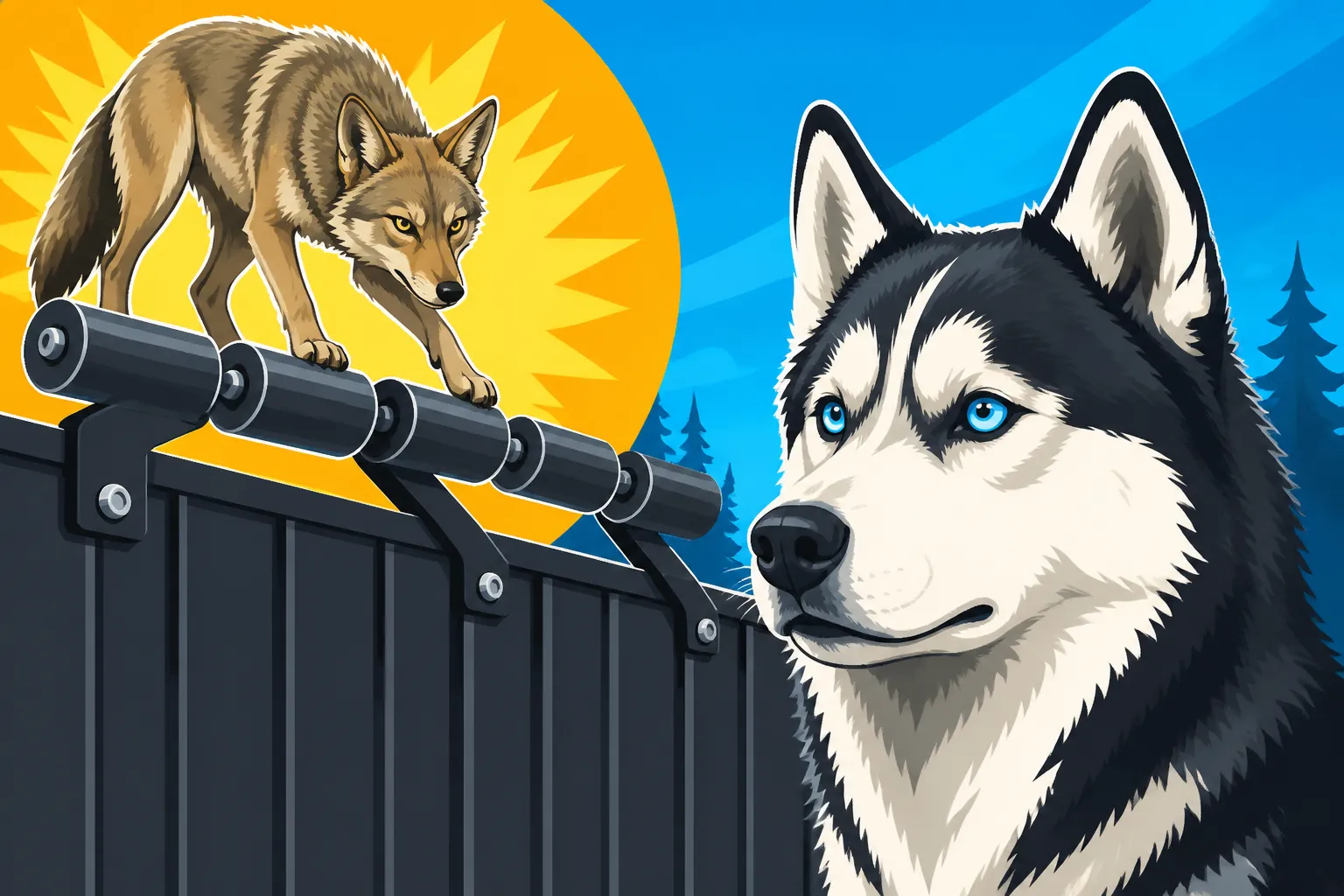
Coyote rollers are essentially a series of long, cylindrical bars or tubes designed to spin freely. They are typically installed horizontally along the very top edge of a fence, extending slightly inward over the enclosure. Imagine a set of large, smooth PVC pipes, aluminum tubes, or even specially designed rollers, affixed with brackets that allow them to rotate with minimal effort. They are not electrified, they don't have spikes, and they won't harm your dog. Their genius lies in simple physics and a clever design that makes it impossible for an animal to gain purchase.
The concept is quite straightforward: when an animal, like a determined Siberian Husky, attempts to scale the fence and grabs or steps on the top rail where the rollers are installed, the rollers immediately spin. This spinning action denies them the stable grip or footing they need to pull themselves over. The effect is that they simply slide back down the fence, unable to conquer the barrier. It's a remarkably effective and humane way to keep even the most athletic climbers contained.
How Coyote Rollers Deter Climbing
The effectiveness of coyote rollers comes down to denying leverage. When your husky jumps, paws, or tries to push off the top of the fence, the roller gives way. It's like trying to climb a slippery, greasy pole that's constantly rotating. No matter how strong your husky's jump, or how desperately they try to find a grip with their paws, the smooth, spinning surface offers no purchase. They can't get that crucial final boost to clear the fence.
Think of it this way: a husky can often use the top of a static fence as a springboard. They get their front paws up, hook a claw, and then use their powerful hind legs to push off and propel themselves over. With a coyote roller, that final handhold or foothold simply isn't there. Their paws touch the spinning cylinder, and they slide right back down. It turns a solid climbing surface into an unstable, impossible-to-grip obstacle. This is especially useful for breeds like the Siberian Husky, known for their incredible agility and ability to Siberian Huskies That Scale Chain Link or even wood fences.
Pros and Cons of Coyote Rollers for Huskies
Before you rush out and buy a whole set of rollers, it’s worth weighing the good against the less-than-ideal aspects. Every solution has its trade-offs, and coyote rollers are no exception when dealing with a breed as unique as the Siberian Husky.
The Advantages: Peace of Mind and Containment
The number one advantage of installing coyote rollers is the incredible peace of mind they offer. For many husky owners, the constant worry of an escape is a heavy burden. We've all been there – hearing a strange noise outside, glancing out, and realizing the yard is suddenly husky-free. It's a gut-wrenching feeling. With coyote rollers, you can significantly reduce the risk of your husky climbing out, allowing you to breathe a little easier when your dog is enjoying time in the yard. No more wondering if they’re going to find that one weak spot or manage to clear the fence this time.
This improved containment isn't just about your sanity; it's about your husky's safety. A loose Siberian Husky is vulnerable to traffic, encounters with other animals, and getting lost far from home. Preventing escapes means preventing potential injuries, costly vet visits, and the heartbreaking possibility of your dog never returning. Proper containment contributes directly to a longer, healthier Siberian Husky Lifespan and What Shortens It. While you should always have good pet insurance like Healthy Paws for unforeseen health issues, a well-secured yard can certainly help minimize claims from escape-related accidents. A dog that is safely contained and happy in their environment is also less stressed, which contributes to their overall well-being and allows them to thrive on a high-quality diet, perhaps delivered conveniently from a service like Ollie.
The Disadvantages: Cost, Installation, and Limitations
Of course, no solution is perfect, and coyote rollers come with their own set of considerations. The most immediate concern for many will be the cost. Coyote rollers represent an additional investment on top of your existing fence. The materials themselves can be pricey, especially for a large yard, and if you opt for professional installation, that will add to the overall expense. It's important to factor this into your budget when you're considering your overall The Fence Bill a Siberian Husky Forces.
Installation, too, can be a bit of a project. While some DIY kits are available, properly measuring, cutting, and securely attaching the rollers to ensure they spin freely and effectively can be challenging, especially on irregular fences or with varied terrain. If not installed correctly, they might not deter your husky, making the investment moot.
| Feature | Pros for Siberian Huskies | Cons for Siberian Huskies |
|---|---|---|
| Primary Function | Prevents climbing over fences | Does not prevent digging under fences |
| Safety | Non-harmful, physical deterrent | Requires secure installation to avoid falling/breakage |
| Effectiveness | Highly effective against climbers/jumpers | May not work if a husky can jump past the rollers |
| Cost | Long-term savings from preventing escapes and injuries | Initial investment can be significant |
| Installation | DIY kits available, professional installation an option | Can be challenging for DIY, may require specific tools |
| Aesthetics | Can be relatively unobtrusive, blends with many fence types | Some find the appearance less appealing than a plain fence |
Perhaps the biggest limitation, and one you absolutely must address if you own a Siberian Husky, is that coyote rollers only solve the climbing problem. They do nothing to deter a husky that loves to dig. If your dog is a dedicated excavator, using their strong paws to create tunnels under the fence, you'll need to combine coyote rollers with other digging prevention strategies. This might involve burying fence wire against a digging Siberian Husky, installing L-footers, or even pouring a concrete footer along the base of your fence. The goal is multi-faceted security against a multi-talented escape artist.
Installation Tips and Complementary Containment Strategies
Deciding to go with coyote rollers is a big step towards a more secure yard, but getting them installed correctly and integrating them into a holistic containment strategy is key. A single solution rarely works in isolation for a Siberian Husky.
DIY vs. Professional Installation Considerations
When it comes to installing coyote rollers, you essentially have two paths: tackle it yourself or hire a professional. Going the DIY route can certainly save you money on labor costs, but it requires a certain level of handiness, the right tools, and careful attention to detail. You'll need to accurately measure your fence lines, acquire the correct type and length of rollers (often PVC piping or specialized kits), and securely attach the brackets so the rollers spin freely but are also firmly mounted. It's crucial that they are installed correctly to prevent any gaps or areas where your husky could still gain purchase. Many homeowners find good quality materials for various fencing projects at stores like Chewy, which might even offer certain types of rollers or fencing accessories. If you're confident in your skills and have experience with home improvement projects, this can be a rewarding way to customize your husky's containment.
However, if you're not comfortable with power tools, precise measurements, or simply don't have the time, hiring a professional fence installer or handyman might be the better option. They can ensure the rollers are installed securely, level, and optimally positioned to prevent escapes. A professional will also be able to navigate any tricky corners, uneven ground, or varying fence heights, providing a polished and effective solution. While it adds to the overall cost, the peace of mind that comes from a properly installed system can be invaluable, especially when dealing with such a determined escape artist.
Combining Rollers with Other Husky-Proofing Measures
As mentioned earlier, coyote rollers are fantastic for stopping climbers, but they won't deter a digger. To truly husky-proof your yard, you need a multi-layered approach.
First and foremost, address digging. For huskies, this is often as big an issue as climbing. You might consider installing L-footers, which are wire mesh extensions buried horizontally into the ground along the fence line, extending inwards into your yard. This creates an invisible barrier that prevents your dog from digging directly under the fence. Another robust option is to bury a wire mesh or concrete footer a foot or two deep along the entire perimeter. Even a simple solution like placing large, heavy rocks or paving stones flush with the ground along the fence line can discourage digging in specific spots. The key is to make digging impossible or, at the very least, extremely inconvenient.
Beyond the physical barriers, consider the human element and your husky's mental stimulation. Even the most secure fence won't compensate for a bored or under-exercised Siberian Husky. These dogs need a job, or at least plenty of physical and mental engagement. Regular, vigorous exercise – think long runs, hikes, or even Canicross and Bikejoring With a Siberian Husky – is crucial. Puzzle toys, training sessions, and interactive play can also help keep their minds occupied, making them less likely to obsess over escaping. Just ensure your Long Lines and Recall Gear for a Siberian Husky is always at hand for those times you're working on their recall in a safe, open area, as a roller-proof fence doesn't magically create an off-leash reliable husky. Additionally, always make sure your gates are securely latched with Gate Locks a Siberian Husky Cannot Open that your clever husky can't figure out. A multi-pronged approach, focusing on both physical barriers and mental/physical enrichment, is the most effective way to keep your Siberian Husky safely and happily contained.
Disclaimer
This article is for general informational purposes only and does not constitute professional advice. Laws, prices and regulations vary by location and change over time. Consult a qualified professional for guidance on your specific situation.