Choosing a Crate a Siberian Husky Cannot Bend
If you've ever come home to find your carefully selected dog crate resembling a modern art sculpture, twisted and mangled, you're likely the proud owner of a Siberian Husky. It's a frustrating, often expensive, cycle for many husky parents: you buy a new crate, convinced this one will hold, only to be proven wrong by your clever, powerful escape artist. This guide is here to help you navigate the world of dog crates specifically for the tenacious Siberian Husky, focusing on options that are designed to withstand their unique determination and strength.
The Inevitable Husky Crate Challenge: Why Standard Crates Just Don't Cut It
Oh, the stories I've heard! And honestly, I've lived a few of them myself. You think you've bought a sturdy crate, perhaps a standard wire one from a big-box store, only to find your Siberian Husky peering at you from the living room, completely unfazed, while the crate lies in shambles behind them. It's not a reflection of your training skills, nor is it necessarily a sign of a "bad" dog; it's simply a testament to the incredible intelligence, strength, and unwavering determination that defines the breed. Huskies were bred to push limits, physically and mentally, and that includes the perceived limits of a dog crate.
The Power and Persistence of a Determined Husky
Siberian Huskies are built for endurance and strength, capable of pulling sleds over vast distances. This inherent physical prowess extends to their problem-solving skills, especially when they decide they'd rather be on the other side of a crate door. Their strong jaws, powerful paws, and lean, muscular bodies are perfectly adapted for tasks that require immense force and sustained effort. When applied to a flimsy wire crate, this means bent bars, sprung latches, and sometimes, even fully dismantled sections. They aren't trying to be destructive in a malicious way; they simply have a strong desire for freedom and an incredible capacity to achieve it.
It's truly something to behold, the sheer ingenuity and brute force a husky can apply to a crate they deem unsatisfactory. They'll systematically test every weakness: the welds, the door hinges, the locking mechanism, the tray underneath. A tiny gap or a slightly loose connection becomes an opportunity. They learn quickly, too, so a trick that worked once might not be necessary the second time because they've already identified the weakest point. This is why a standard, lightweight wire crate is often seen less as a secure enclosure and more as a puzzle to be solved, or simply a mild inconvenience, for a determined husky.
The Costly Cycle of Failed Crates
Let's be real, replacing crates isn't cheap. Many husky owners find themselves in a frustrating and expensive loop: buy a "better" crate, watch the husky escape, then go back to the drawing board. This cycle can quickly add up, not just in terms of monetary cost for new crates, but also in potential damage to your home and the stress it causes you and your dog. An escaped husky can chew furniture, have accidents, or, even worse, get into dangerous situations if they manage to get out of the house. This is a common pain point that leads many to search for something truly indestructible.
Beyond the immediate financial hit, there's the emotional toll. You want your dog to be safe and comfortable when you can't supervise them, and a failed crate undermines that sense of security. It can also lead to frustration with your husky, when in reality, they're just being true to their nature. Investing in the right crate from the start, one designed specifically for powerful breeds and escape artists, can save you a lot of headache, heartache, and money in the long run. It shifts the focus from containment battles to consistent, positive training within a secure environment.
Understanding Crate Construction: What Makes a Crate Husky-Proof?
When you're dealing with a canine Houdini like a Siberian Husky, you can't just pick any crate off the shelf. You need to understand what makes a crate genuinely robust and resistant to their clever escape tactics. It's all about the materials, the design, and the quality of craftsmanship that goes into its construction. Think of it less like buying a pet accessory and more like investing in a security feature for your home and your dog's safety.
Material Matters: From Standard Wire to Heavy-Duty Steel
The biggest difference between a crate your husky will bend and one they won't often comes down to the material. Standard wire crates, while convenient and affordable, are typically made of thinner gauge wire. This wire can be bent, chewed, and even snapped by a strong, persistent husky. You might find a standard wire crate that looks sturdy, but if the wire itself can be easily manipulated, it won't stand a chance.
For a Siberian Husky, you need to look for crates made from much heavier materials. This usually means high-gauge steel or even industrial-strength aluminum. These materials are far more resistant to bending, chewing, and distortion. Some specialized crates use a thicker, square-tube steel frame, which offers incredible rigidity and makes it virtually impossible for a husky to twist or break. When you feel the difference in weight and density between a standard wire crate and a heavy-duty steel one, it's immediately obvious which one is built to last against a determined husky.
Locking Mechanisms and Secure Latches
A crate is only as secure as its weakest point, and often, that's the latch. Standard wire crates often feature simple slide-bolt latches or even single-point clips. A clever husky can quickly learn to manipulate these with their nose, paws, or even by ramming the door. They might just need to create enough give to slide the bolt open. I've even seen videos of huskies figuring out how to lift and slide traditional crate latches with startling precision!
For a husky-proof crate, you need much more robust and complex locking mechanisms. Look for multiple slide-bolt latches, often one at the top and one at the bottom of the door, or even a central latch that engages with multiple points. Some of the most secure crates feature spring-loaded latches, heavy-duty deadbolts, or even locking clasps that require a human hand to operate in a specific way. The goal is to make it impossible for your husky to accidentally (or intentionally) jostle the door open or slide a bolt into an unlocked position. These superior locking mechanisms are a non-negotiable feature if you want to keep your husky safely contained.
Design and Weld Quality
It's not just about the thickness of the metal; it's also about how it's put together. Many flimsy crates have spot welds that can break under pressure, allowing sections to come apart. A determined husky will find these weak points and exploit them. Imagine a weld giving way as your husky pushes against it, creating an opening large enough to squeeze through.
High-quality, husky-proof crates will feature continuous welds or very strong, reinforced connections. The frame should be solid and not easily flexed or twisted. Look for crates with minimal gaps between the bars, especially at stress points like corners or around the door frame. A crate with a reinforced frame, perhaps with additional cross-bracing, will distribute force more effectively and prevent any single point from becoming a weak link. Pay attention to how the panels connect, too; some heavy-duty crates bolt together, offering superior strength compared to folding designs that might have more flex points. You're looking for a fortress, not just a cage.
Types of Crates for the Escape Artist Siberian Husky
Given their strength and intelligence, not all crate types are created equal when it comes to containing a Siberian Husky. While the variety on the market is vast, narrowing down your options to those designed for extreme durability is key. For many husky owners, this means bypassing the commonly available options and investing in something more specialized. If you're tired of replacing crates or worrying about your dog's safety, understanding these distinctions is critical.
Heavy-Duty Steel Crates: The Gold Standard
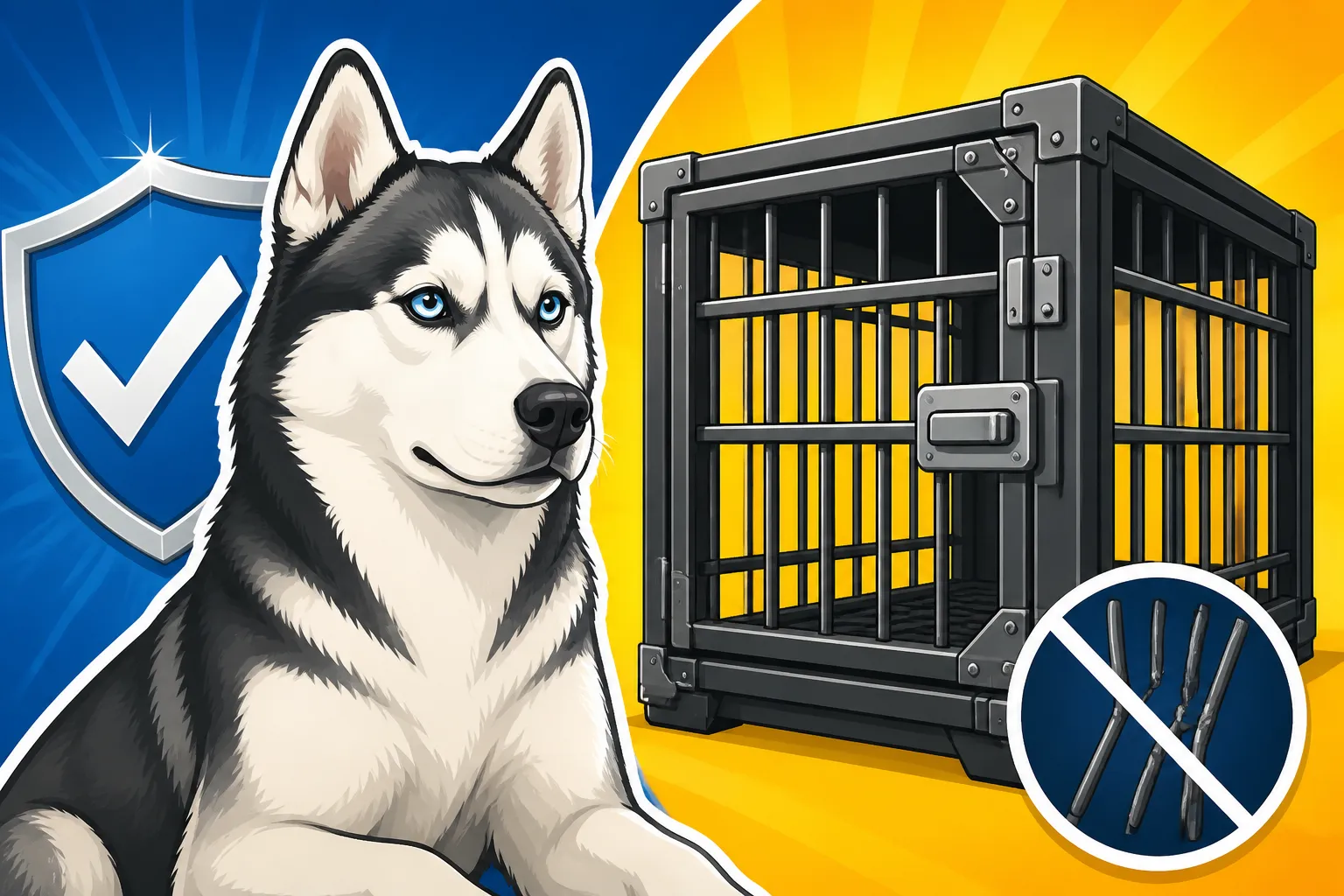
When it comes to preventing escapes and containing even the most determined Siberian Husky, heavy-duty steel crates are, without a doubt, the gold standard. These aren't your grandmother's flimsy wire crates. They are constructed from thick, high-gauge steel tubing or solid steel bars, often with a powder-coated finish for durability and rust resistance. The sheer weight and rigidity of these crates make them incredibly difficult, if not impossible, for a husky to bend, chew, or dismantle.
These crates typically feature industrial-strength welds, multiple secure latches that often require two hands to operate, and a solid, immovable structure. Many have a grated floor and a removable tray underneath for easy cleaning, but the important part is the main structure. They are designed to withstand significant force and persistent escape attempts. While they come with a higher price tag and are much heavier to move, the peace of mind they offer is often invaluable. Many brands specialize in these types of crates, with some even advertising "escape-proof" designs. When looking on sites like Amazon, search specifically for "heavy-duty dog crate" or "escape-proof dog crate" to filter for these robust options. Remember, for a Siberian Husky, this isn't an upgrade; it's a necessity. You might even find some excellent feedback for specific models in communities dedicated to breeds known for their escape artistry.
Reinforced Wire Crates: A Step Up from Basic
If a full-on heavy-duty steel crate feels like too much of an initial leap, a reinforced wire crate can be a viable intermediate step, provided you choose wisely. These are a step up from the standard, lightweight wire crates but are not as robust as the fully heavy-duty steel options. The key difference lies in the gauge of the wire and the quality of the connectors and latches.
Reinforced wire crates will use thicker wire throughout, making it harder to bend or break. They may also feature stronger, multi-point locking systems and more substantial welds at the joints. Some also incorporate corner reinforcements or a slightly heavier frame. However, it's crucial to understand their limitations. A truly determined husky might still find a way to bend a reinforced wire if it's not thick enough, or if the latches aren't truly secure. These types of crates might work well for a husky that is not a persistent escape artist, or for very short periods, but for those known for their Houdini acts, they might still prove insufficient. Always double-check reviews from owners of strong, active breeds before committing to this type.
| Crate Type | Material | Strength for Huskies | Portability | Price Range | Common Use Cases |
|---|---|---|---|---|---|
| Standard Wire | Thin steel wire | Poor (easily bent) | High | Low | Small puppies, calm dogs, short-term containment |
| Reinforced Wire | Thicker steel wire | Moderate (can still be bent by strong dogs) | Medium | Medium | Growing puppies, less determined dogs, supervised use |
| Heavy-Duty Steel | Thick steel tubing/bars | Excellent (highly resistant to escape) | Low | High | Escape artists, destructive chewers, long-term containment |
| Plastic (Kennel) | Hard molded plastic | Low (can be chewed/broken) | Medium | Medium | Travel, privacy for calm dogs |
| Fabric | Soft fabric, mesh panels | Very Poor (easily torn) | Very High | Low | Very calm dogs, temporary soft carriers, car rides |
Avoiding Plastic and Fabric Crates for Determined Huskies
While plastic and fabric crates have their place for certain dogs and situations, they are almost universally unsuitable for Siberian Huskies known for their escape attempts or destructive tendencies. Frankly, suggesting them for a husky that bends bars is like offering a sieve to bail out a sinking ship.
Plastic crates, often called "kennels," are fantastic for travel or for dogs who genuinely enjoy the den-like feel and don't try to chew their way out. However, the plastic air vents and door frames are often vulnerable to a husky's powerful jaws. A persistent chewer can quickly widen ventilation holes or even break through the plastic around the door, compromising the crate's integrity. These are simply not built to withstand the sustained chewing or ramming force of a strong husky.
Fabric crates, on the other hand, are the epitome of portability and lightness. They're great for very short-term, supervised use with an already crate-trained, non-anxious dog, or as a soft carrier for trips. For a husky, they are little more than a suggestion. The mesh panels and zippers offer absolutely no resistance to a husky's claws or teeth. Within minutes, a determined husky can tear through the fabric, unravel zippers, and be free. Save these types of crates for car rides for dogs who are perfectly content, or for very temporary, fully supervised uses where escape is not a concern. For a husky that needs secure containment, they are a definite no-go.
Beyond the Bars: Key Considerations for Crate Success
Choosing the right crate material and construction is a massive step, but it's not the only factor in achieving crate success with your Siberian Husky. The most indestructible crate in the world won't be effective if it's the wrong size, placed poorly, or, most importantly, if your husky hasn't been properly introduced and trained to love their crate. Remember, the goal is for the crate to be a safe, comfortable den, not a prison.
Sizing It Right: Comfort and Security
You might think bigger is always better for a powerful, active dog like a husky, but with crates, there's a delicate balance to strike between comfort and security. A crate that's too large can actually encourage inappropriate elimination habits, as your husky might designate one end as a potty area. It also gives them more room to build momentum for pushing or ramming against the sides, potentially exploiting weaknesses more easily.
Conversely, a crate that's too small is cruel and will lead to anxiety, stress, and a desperate desire to escape. Your husky should be able to stand up, turn around easily, and lie down comfortably in a natural position. Their head shouldn't touch the top of the crate when standing. Measure your husky from the tip of their nose to the base of their tail, and from the top of their head to the floor when standing. Add a few inches to these measurements to find the ideal crate dimensions. Many heavy-duty crate manufacturers will provide sizing guidelines, so make sure to consult those before purchasing. A properly sized crate is crucial for both their physical comfort and your peace of mind.
Crate Placement and Environment
Where you put the crate can have a big impact on your husky's willingness to use it. Huskies are social animals, and often, being isolated in a crate in a remote part of the house can lead to feelings of loneliness or anxiety, exacerbating any escape attempts. Placing the crate in a common area, like the living room or bedroom, where they can still feel like part of the family, can make a huge difference. They can hear and smell you, which can provide comfort.
Consider the environment around the crate as well. Is it in a high-traffic area where they feel constantly disturbed? Or is it quiet and calm? Make sure the temperature is comfortable; huskies have thick double coats and can overheat easily, so avoid direct sunlight or poorly ventilated areas. A fan pointed nearby can help. Think about making the crate itself cozy: soft bedding, a favorite Puzzle Feeders a Siberian Husky Cannot Beat stuffed with treats, or a safe chew toy can make it a much more inviting space. For a really anxious husky, covering part of the crate with a blanket can provide a sense of security, mimicking a den.
Training is Paramount: The Crate as a Safe Den, Not a Jail
Even the most robust, heavy-duty crate is merely a tool. Its effectiveness ultimately hinges on how you introduce and utilize it with your Siberian Husky. The goal is to build a positive association, turning the crate into a sanctuary where they choose to relax, rather than a punishment they desperately try to escape. This means consistent, patient, and positive reinforcement-based training. Training an Independent Siberian Husky definitely applies here, as their independent nature means they respond best to cooperation, not coercion.
Start slowly. Never force your husky into the crate. Lure them in with high-value Food Rewards a Siberian Husky Will Work For and praise. Feed them meals inside the crate with the door open, then with the door closed for short periods. Gradually increase the time they spend in the crate, always returning before they show signs of distress. Use a calm, reassuring tone. Leave them with a special, high-value chew that they only get in the crate. This teaches them that good things happen there. If your husky shows signs of A Siberian Husky That Panics in a Crate, you need to slow down the training process significantly, or even consult a professional dog trainer specializing in fear and anxiety.
It’s also important to manage your expectations regarding Hours a Siberian Husky Copes With Alone. Even with the best crate and training, huskies need ample exercise and mental stimulation before being crated. A bored or unexercised husky is far more likely to try to escape, regardless of the crate's strength. Remember, the crate is a temporary management tool, not a substitute for proper exercise, training, and companionship. Resources like BAXTER & Bella offer online puppy training programs that can guide you through positive crate training, helping you build a strong foundation. This approach is far more effective than simply relying on a sturdy crate alone to prevent Siberian Husky Destruction When Left Alone or Siberian Husky Separation Behavior. While you might wonder Whether Every Siberian Husky Needs a Crate, for many, it provides a safe, contained space that is invaluable for management and safety.
Disclaimer
This article is for general informational purposes only and does not constitute professional advice. Laws, prices and regulations vary by location and change over time. Consult a qualified professional for guidance on your specific situation.