Microchip Registration for a Siberian Husky
There’s a unique dread that washes over any Siberian Husky owner the moment they realize their beloved companion isn't where they should be. Huskies are notorious escape artists and wanderers, and that instant of panic can be gut-wrenching. This guide is all about giving you the best chance of a happy reunion by diving deep into microchip registration, ensuring your husky’s tiny identifying chip is actually a lifeline, not just a forgotten piece of tech.
Understanding Your Siberian Husky's Microchip
It's one thing to have a microchip implanted; it's quite another to understand what it is, how it works, and why it's so incredibly vital for a breed like the Siberian Husky. Many people get the chip done at the vet or from the breeder and think "job done." But there's a crucial second step that often gets missed, and that's the real difference-maker.
What a Microchip Actually Is and Isn't
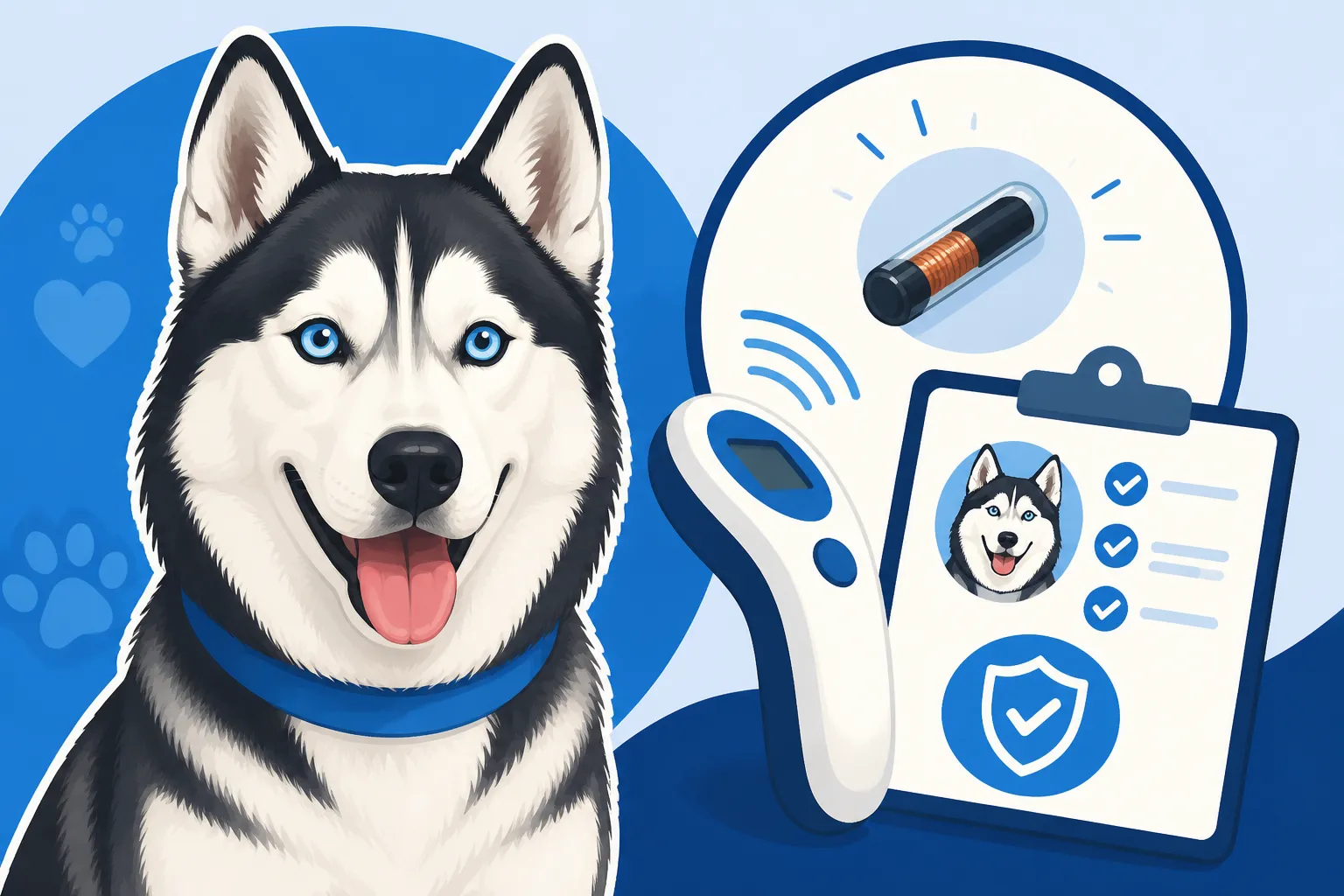
Let's clear up a common misconception right away: a microchip is not a GPS tracker. I know, I know, wouldn't that be amazing? To just pull out your phone and see exactly where your adventurous husky has bolted off to? Sadly, that technology isn't available in a tiny, implantable chip that lasts a lifetime without a battery. The microchip itself is a passive RFID (Radio-Frequency Identification) device, about the size of a grain of rice. It sits just under your husky's skin, usually between the shoulder blades.
When a veterinarian or animal shelter scans a lost pet, the scanner emits a radio wave that activates the chip. The chip then transmits its unique identification number back to the scanner. That's it! It's a permanent ID number, like a social security number for your dog, that can be read by a special device. It has no internal power source, it doesn't transmit signals on its own, and it definitely won't tell you if your husky is currently making friends with the mailman three towns over. It's a critical tool for identification, but only if the number is properly connected to your contact information.
This distinction is especially important for Siberian Husky owners because these dogs are driven by an innate desire to explore. Their athleticism, intelligence, and often mischievous nature mean they can clear fences, open gates, and slip leashes with astonishing ease. Without a GPS, the microchip's job is purely to identify them once they're found, so that finding them actually leads them home.
The Importance of Microchipping for Huskies
For a breed with the Siberian Husky's strong roaming instinct, a microchip isn't just a good idea; it's an absolute necessity. These dogs were bred to cover vast distances, and their natural curiosity combined with an independent streak means they can be out of sight and out of mind faster than you can say "squirrel!" The Roaming Instinct Bred Into Every Siberian Husky is powerful, and it means they don't always think like other dogs when they're off exploring.
Consider the heart-wrenching statistics: countless studies show that microchipped dogs are returned to their owners at significantly higher rates than those without chips. Even with an ID tag, collars can fall off, tags can be lost, and phone numbers can become unreadable. A microchip is a permanent, tamper-proof form of identification that stays with your husky for their entire life. It's the last line of defense.
Knowing your husky has a microchip offers a small but significant layer of peace of mind. While it won't prevent them from getting lost, it drastically increases the odds of a happy reunion. Every time I hear a story about a husky being reunited with their family weeks, months, or even years after going missing, it almost always comes down to that tiny chip and an updated registration. It's an investment in your sanity and your dog's safety.
The Critical Step: Registering Your Siberian Husky's Microchip
Having the microchip implanted is only half the battle, maybe even less. The real magic, the thing that actually connects that unique number to you, happens with registration. This is where many owners unintentionally drop the ball, and it can have devastating consequences.
Why Registration is Non-Negotiable
Imagine this: your adventurous Siberian Husky, known for their uncanny ability to Why a Siberian Husky Cannot Be Trusted Off Leash, decides to take themselves on an unauthorized adventure. Days later, they're picked up by animal control, scanned, and a microchip number appears. Great! Except… when the shelter calls the microchip registry, the number either isn't registered, or it's still registered to the breeder's information from three years ago. Suddenly, that incredibly helpful piece of technology is utterly useless.
This scenario plays out far too often. Many assume the vet registers the chip automatically, or that the breeder's initial registration is permanent. While some vets and breeders do initiate the registration process, it's ultimately your responsibility as the owner to confirm it's completed and that your current contact information is on file. A microchip without current registration is just a foreign object under your dog's skin; it doesn't do a thing to bring them home.
It's a common and understandable oversight, but one that can lead to untold stress and heartbreak. Animal shelters are often overflowing, and while they want to reunite pets with their families, they can only work with the information they're given. Don't let your husky become another statistic because of a forgotten form or an outdated phone number. The few minutes it takes to register or update are truly non-negotiable for their safety.
How to Register Your Microchip
Registering your Siberian Husky's microchip is usually a straightforward process, but it requires a little attention to detail.
First, you need the microchip number. This is typically a 9, 10, or 15-digit number that should be on your husky's vet records, their health certificate, or paperwork provided by the breeder. If you don't have it, your vet can scan your dog and tell you the number. When you're looking at Reading a Siberian Husky Puppy's Health Paperwork, make sure that microchip number is clearly written down.
Next, you'll choose a microchip registry. There are many options available, some free and some paid. Some popular choices include registries associated with the chip manufacturer (like Avid, HomeAgain, 24PetWatch) or universal registries that link to various chip brands. A good starting point is to use a universal microchip lookup tool online – if you enter your husky's microchip number, it should tell you which registry it's currently associated with, or if it’s registered at all.
Once you’ve picked a registry, you'll go to their website or call them directly. You'll need to create an account and then enter your husky's microchip number along with all your contact information: your full name, current address, phone numbers (home, cell, work), and email address. Many registries also allow you to add an emergency contact, which can be invaluable if you're unreachable. Some registries, like HomeAgain, offer additional benefits like lost pet alerts and a national network, often for an annual fee. Others, like PetLink, offer free registration with the option for premium services. It's worth comparing what each offers for your needs.
| Registry Type | Cost | Key Features | Considerations |
|---|---|---|---|
| Manufacturer-Specific | Often Free (initial) | Links directly to chip brand, may offer upgrades | Might require annual fees for full services; tied to one chip brand |
| Universal Registries | Varies (free to paid) | Accepts all chip brands, central database lookup | Can be confusing with multiple options; check features carefully |
| National Pet Recovery | Annual Fee | 24/7 lost pet recovery service, lost pet alerts | Higher cost, but comprehensive support if your pet goes missing |
Once all your information is entered and saved, you're good to go! Just make sure to keep a copy of your registration confirmation, whether it's a screenshot, an email, or a physical card, and perhaps even include it with your Costing Out a Siberian Husky From Puppy to Senior budget paperwork.
Checking and Updating Your Registration Information
Life happens! You move, you change phone numbers, you switch email providers. These are all reasons why it's absolutely vital to regularly check and update your Siberian Husky's microchip registration. I can't stress this enough: an outdated microchip registration is just as useless as no registration at all. Imagine a shelter calling a disconnected number while your husky waits anxiously for you.
Most microchip registries provide an online portal where you can easily log in and manage your pet's information. I make it a point to log in at least once a year, usually around my husky's birthday or during a routine vet visit, just to verify everything is still accurate. It takes literally five minutes and saves a world of potential heartache. If you don't remember your login, most sites have a "forgot password" option, or you can call their customer service.
If you move to a new town, get a new cell phone, or even transfer ownership of your husky to another family member (though we certainly hope that doesn't happen often!), updating the microchip registration should be as high on your priority list as changing your mailing address. This is especially important for Siberian Huskies who are prone to escaping; the faster an animal facility can reach you, the better the outcome. Without current information, that microchip might lead to a dead end, prolonging the time your husky is away from you and potentially putting them at Siberian Husky Deaths From Trauma and Escape or facing Animal Control Fines for a Loose Siberian Husky.
Navigating Microchip Registries and Services
The world of microchip registries can seem a little overwhelming, with different companies, different features, and sometimes varying costs. The key is understanding what they offer and how they contribute to getting your husky back home.
Common Microchip Registries and Their Offerings
When it comes to registries, you'll encounter a few main types. There are manufacturer-specific registries, like HomeAgain or AVID, which are often the primary registry for the chip brand they produce. Then there are universal registries that consolidate data from various chip brands, aiming to be a one-stop shop for lookup services. Finally, there are national pet recovery services that might offer additional perks.
Many registries offer more than just basic contact information storage. Some, especially those with an annual fee, might include:
- 24/7 Pet Recovery Service: Dedicated staff to assist with lost pet reports and facilitate communication.
- Lost Pet Alerts: Sending out emails or texts to shelters and veterinarians in your area when your pet goes missing.
- Travel Assistance: Guidance if your pet gets lost far from home.
- Pet Poison Helpline Access: Though not directly microchip related, some services bundle this in.
- Medical Emergency Funds: A small fund to cover initial emergency care if your pet is injured while lost.
When considering options, look for registries that are recognized by veterinary associations and animal welfare organizations. While basic registration might be free through some services, sometimes the peace of mind and enhanced services of a paid registry are well worth the annual fee, especially with a breed like the Siberian Husky that truly puts those escape-artist rumors to the test. Even if you have pet insurance like Healthy Paws, which helps with vet bills, microchip registration is a separate, vital layer of protection that ensures those vet bills are for a found dog.
What Happens When a Microchipped Husky is Found
Let's walk through the ideal scenario when a microchipped Siberian Husky is found. Your husky, perhaps after demonstrating How Far a Loose Siberian Husky Travels, is picked up by a kind stranger or animal control. Their first stop is typically an animal shelter or veterinary clinic.
Upon arrival, the staff will use a universal microchip scanner to check for a chip. These scanners can read almost all microchips, regardless of brand. Once the chip is detected, its unique ID number will appear on the scanner. The staff then takes that number and inputs it into a national microchip lookup tool online. This tool will usually indicate which specific registry the chip is associated with.
From there, the shelter or clinic will contact that registry. The registry, having your up-to-date contact information on file, will then call or email you immediately to inform you that your husky has been found! This rapid notification is the dream outcome, significantly reducing the time your husky spends in a stressful shelter environment and alleviating your worry. What Losing a Siberian Husky Costs emotionally and financially can be immense, so this streamlined process is invaluable.
The critical takeaway here is that every step of this process relies on that microchip being correctly registered with your current contact information. Without it, the system breaks down, and your husky's journey home becomes much longer and more uncertain, potentially exposing them to Why an Escaped Siberian Husky Is a Health Risk.
Beyond the Microchip: Additional Safety Measures for Your Siberian Husky
While the microchip is an indispensable tool, it's just one part of a comprehensive safety plan for your Siberian Husky. Given their unique traits, a multi-layered approach is always best.
Traditional ID Tags and GPS Collars
Think of your husky's microchip as the ultimate backup plan, but it's not the first line of defense. That role still belongs to a good old-fashioned ID tag on their collar. Why? Because a visible ID tag with your phone number provides immediate contact information to anyone who finds your dog. They don't need a scanner; they just need to read the tag and make a call. This can often lead to the quickest reunions, sometimes before your husky even makes it to a shelter.
Even though Siberian Huskies are notoriously good at slipping collars, a well-fitted, sturdy collar with a clearly engraved tag is still essential. Consider adding your husky's name, your phone number, and perhaps a note like "Microchipped" or "Needs Meds" if applicable. Some owners even put their city and state, or a reward offer. These tags are inexpensive and provide instant gratification for a good samaritan. You can find durable tags and collars easily at pet supply stores or online retailers like Chewy, ensuring your husky has all bases covered.
For the ultimate real-time peace of mind, consider a GPS collar. Unlike a microchip, a GPS collar does have a battery and does transmit your husky's location. This is a game-changer for a breed with a high prey drive and a wanderlust spirit. While it's an added expense and requires charging, the ability to open an app and see exactly where your husky is can save hours of frantic searching and immense anxiety. Check out GPS Collars Worth Buying for a Siberian Husky for more detailed information on selecting one that suits your needs. These tools work in tandem: the GPS helps you track them before they're found by others, and the microchip (along with an ID tag) ensures identification after they are found.
Secure Containment and Training
Ultimately, the best defense against a lost Siberian Husky is prevention. This means focusing on secure containment and rigorous training that takes their breed characteristics into account. Huskies are athletes and master problem-solvers when it comes to fences and gates. A standard four-foot fence often won't cut it. Many husky owners find they need a The Six-Foot Fence a Siberian Husky Needs that is not only tall but also secured at the bottom with an L-footer or buried wire to prevent digging, and potentially Coyote Rollers on a Siberian Husky Fence at the top to deter climbing.
Beyond physical barriers, training is paramount. Teaching your husky a rock-solid recall, even though they are independent, is critical. It takes patience, consistency, and high-value rewards, but it's not impossible to teach them to Teaching a Siberian Husky to Come Back – even if that recall is only reliable in a fenced area. Leash training to prevent pulling and slipping out of harnesses is also vital.
By investing in secure fencing, proactive training, and maybe even quality nutrition from brands like Ollie to support their overall health and energy levels, you're building a foundation that minimizes the chances of them ever needing that microchip to begin with. The goal is always to keep them safe and sound at home, and the microchip is there as the fail-safe, the silent guardian waiting to bring them back should all other efforts fail.
Disclaimer
This article is for general informational purposes only and does not constitute professional advice. Laws, prices and regulations vary by location and change over time. Consult a qualified professional for guidance on your specific situation.