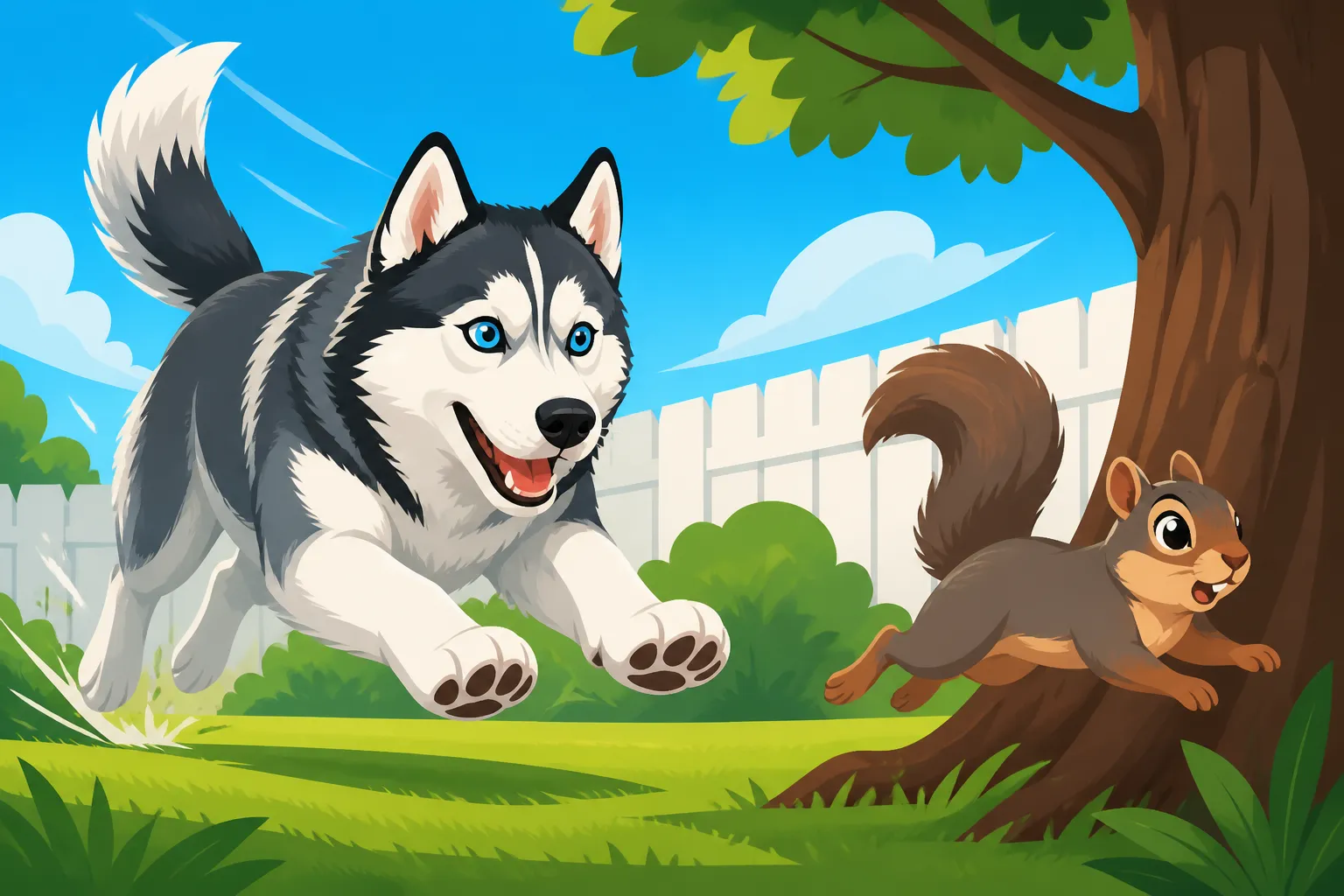
A Siberian Husky That Chases Backyard Squirrels
If you're a Siberian Husky owner, you know the drill: that sudden laser focus, the low crouch, and then the explosive burst of speed as your beloved fur missile launches itself after a hapless squirrel in the backyard. It's frustrating, sometimes dangerous for the squirrel, and often a source of worry for us. This guide is here to help you understand why your Husky acts this way and, more importantly, how you can manage that intense prey drive to keep both your yard and the local wildlife (and your sanity!) a little safer.
Understanding the Husky's Deep-Seated Prey Drive
One of the most common frustrations new Siberian Husky owners face, and even seasoned ones, is their dog's relentless pursuit of anything small and scurry. From squirrels to rabbits, birds, and even stray cats, if it moves, a Husky's instinct screams "chase!" It's easy to get upset, to think your dog is being disobedient, but the truth is, this behavior is a fundamental part of what makes a Husky a Husky. It's not a flaw; it's a feature, deeply embedded in their DNA.
Instinctual Roots of the Chase
To truly understand this behavior, we have to look back at the Siberian Husky's origins. These dogs were bred for centuries by the Chukchi people of northeastern Siberia, not just as sled dogs, but as survival partners. Their environment was harsh, food could be scarce, and their lives often depended on their ability to work efficiently and to occasionally supplement their diet. This meant being alert, swift, and possessing a keen eye for small game. The very traits that made them excellent sled dogs – speed, endurance, and an independent spirit – also fueled their strong prey drive. They needed to be able to spot, pursue, and sometimes catch small animals for survival.
This isn't just about food, though. It's also about movement. Their ancestors were driven to respond instantly to the flick of a rabbit's tail or the dart of a rodent. This impulse is powerful, almost involuntary, and it's why a Husky can go from a relaxed sunbath to a full-speed chase in a fraction of a second. It's less about malice or disobedience and more about a hard-wired genetic program that has served their breed for millennia. Siberian Husky Prey Drive Around Small Animals delves deeper into these instinctual behaviors.
Not a Nuisance, But a Feature of the Breed
While it can certainly feel like a nuisance when your dog is tearing up your flowerbeds in pursuit of a bushy-tailed bandit, it's important to reframe this behavior not as a problem with your individual dog, but as a characteristic of the breed itself. Just as a Border Collie is driven to herd, a Husky is driven to chase. This fundamental drive means that no amount of scolding or punishment will ever truly "train out" the instinct. What we, as responsible owners, can do is learn to manage it, redirect it, and create environments where both our Huskies and the local wildlife can coexist more safely.
Accepting this inherent trait is the first step towards a more harmonious relationship with your Husky. Instead of fighting against their nature, we can work with it, providing appropriate outlets and strong boundaries. It's about understanding that their drive isn't a personal affront, but a testament to their incredible heritage as resilient, intelligent working dogs. Their entire physical makeup, from their powerful hindquarters to their agile bodies, is designed for this kind of explosive movement.
Variations in Drive Among Individuals
Of course, like humans, every Husky is an individual, and the intensity of their prey drive can vary. Some Huskies might only show a mild interest in a distant squirrel, content with a casual glance. Others will react to the slightest rustle of leaves, their entire body tensing with the thrill of the chase. These variations can be influenced by genetics, early life experiences, and even the dog's overall exercise and mental stimulation levels. A bored Husky, for instance, might be even more inclined to fixate on a squirrel as a source of entertainment.
It's also worth noting that a Husky's prey drive isn't always limited to actual animals. Some might chase leaves blowing in the wind, shadows, or even reflections. Observing your own Husky will give you valuable insights into their specific triggers and the intensity of their reaction. This knowledge is crucial for developing an effective management and training plan tailored to your dog's unique personality and drive. What works for one Husky might not be sufficient for another, so careful observation is key.
Why Squirrels Are Such an Irresistible Temptation
Squirrels, with their erratic movements, chattering calls, and quick dashes, are practically custom-designed to trigger a Husky's prey drive. They embody everything a high-drive dog is instinctively programmed to pursue, making them far more enticing than, say, a slow-moving garden snail. Understanding why squirrels are such a magnet for your Husky's attention can help you anticipate and manage these interactions more effectively.
Movement and Sound: The Ultimate Triggers
The primary trigger for a Husky's chase instinct is movement. Squirrels are masters of sudden, unpredictable motion – a quick scamper up a tree, a daring leap between branches, a frantic dash across the lawn. This rapid, jerky movement immediately activates the Husky's predatory sequence: orient, eye, stalk, chase, grab, bite. Even if your Husky never gets past the chase phase, the instinct to pursue is incredibly strong. The faster and more erratic the movement, the more exciting it is for your dog.
Beyond just movement, the sounds squirrels make also play a significant role. Their chattering, chirping, and alarm calls can act like a siren call to a Husky. These sounds indicate the presence of potential "game," alerting your dog to their location even before they see them. A Husky's keen hearing, developed over generations in vast, open spaces, makes them incredibly sensitive to these subtle auditory cues. The combination of visual and auditory stimuli creates an almost irresistible urge to investigate and pursue.
The "Game" Aspect: Self-Rewarding Behavior
For a Siberian Husky, chasing a squirrel isn't just about catching it; it's often about the thrill of the chase itself. It's an incredibly self-rewarding behavior. The adrenaline rush, the burst of speed, the intense focus – these all provide a natural high for a dog bred for explosive energy and independent action. Even if the squirrel escapes (which they usually do, much to our relief!), the act of chasing has provided its own reward, reinforcing the behavior for next time. Why a Siberian Husky Cannot Be Trusted Off Leash highlights the risks associated with this powerful drive.
This "game" element makes it incredibly hard to interrupt once it's started. Your Husky isn't thinking about your recall cue or the boundaries of the yard; they're fully immersed in the ancient dance of predator and prey. This is why prevention and redirection are so much more effective than trying to stop a chase once it's in full swing. The satisfaction derived from the pursuit itself is often enough to keep them coming back for more, day after day.
Boundary Pushing: How Squirrels Exploit Yard Weaknesses
Squirrels are intelligent and opportunistic creatures. They quickly learn the routines of a household and the boundaries of a yard. They know which trees offer safe havens, where the fence might have a weak spot, and when the "big dog" is most likely to be out. They might even intentionally tease a dog from a safe perch, further fueling the chase instinct. This interaction can feel like a constant battle of wits between your Husky and the local squirrel population.
A determined squirrel can quickly exploit any perceived weakness in your yard's security, turning a seemingly impenetrable fence into a launchpad for escape or intrusion. This creates a dangerous situation where your Husky's prey drive, combined with a squirrel's agility, can lead to escapes or even confrontations that go beyond mere chasing. It reinforces the need for robust containment measures, which we'll discuss in the next section, to ensure your Husky remains safely within your property lines.
Practical Management Strategies in the Yard
Since you can't "train out" a Husky's prey drive, the most effective approach to managing a Siberian Husky that chases backyard squirrels is through proactive management. This means creating an environment where the opportunities for dangerous or destructive chase behaviors are minimized. It’s about being smarter than the squirrels and more vigilant than your dog's instincts.
Securing Your Perimeter: Fences, L-Footers, and Gate Checks
The first, and arguably most critical, step is to ensure your yard is a fortress. Siberian Huskies are notorious escape artists, and a strong prey drive only amplifies their determination to breach any barrier. A standard four-foot fence often isn't enough; Huskies can easily clear it or, if not, find a way under. You should aim for a fence that is at least six feet tall. The Six-Foot Fence a Siberian Husky Needs explains why this height is essential.
Beyond height, focus on the ground level. Huskies are expert diggers. Installing an L-footer – either by burying chicken wire horizontally along the fence line, extending concrete footers, or placing large pavers – can prevent your Husky from digging their way out in pursuit of a tunneling squirrel. Adding an L-Footer Against Siberian Husky Digging provides detailed guidance on this. Regularly inspect your fence line for any new weaknesses, loose boards, or gaps. Don't forget the gates! Ensure they have strong, Husky-proof latches, and consider double-latching or adding carabiners for extra security. Some Huskies are even clever enough to operate simple gate mechanisms, so always check them. You can find robust fencing materials and security upgrades on platforms like Amazon to help reinforce your perimeter.
Active Supervision: Never Leave a Husky Unattended
This might sound simple, but it's often overlooked: never leave a Siberian Husky unattended in the yard, especially if you know squirrels are present. Even the most secure yard can have a weak spot a determined Husky can find, and a few minutes of unsupervised time is all it takes for a chase to escalate into an escape. Huskies are clever, opportunistic, and their prey drive provides immense motivation.
Active supervision means you are actively watching your dog, ready to intervene. This isn't just about preventing escapes; it's also about preventing successful chases within the yard. If you see your Husky beginning to fixate on a squirrel, you can immediately redirect their attention with a verbal cue, a toy, or by bringing them inside. This constant vigilance is key to preventing the self-rewarding cycle of the chase from taking hold. Supervising a Siberian Husky in an Unfenced Yard offers insights into managing Huskies in less-than-ideal containment.
Environmental Enrichment: Diverting Attention
A bored Husky is a destructive and driven Husky. If your dog isn't getting enough physical exercise or mental stimulation, they're far more likely to invent their own entertainment, and chasing squirrels becomes a prime candidate. Provide plenty of appropriate outlets for their energy. This includes regular, vigorous exercise outside the yard, like long walks, runs, or engaging in dog sports.
Within the yard, offer enriching activities that compete with the allure of squirrels. Puzzle toys filled with treats, sturdy chew toys, or even a designated digging pit (far away from the fence line!) can give your Husky an acceptable outlet for their natural instincts. Rotate toys regularly to keep things fresh and exciting. A tired and mentally stimulated Husky is less likely to be hyper-focused on every rustle in the leaves.
Leash and Long Line Management in the Yard
Even within a seemingly secure backyard, it can be a good idea to utilize a leash or a long line, especially during times when you know squirrels are most active (e.g., early morning or late afternoon). A long line, attached to a secure harness, gives your Husky a sense of freedom to explore while still allowing you to safely interrupt a chase before it gathers momentum. This is an excellent tool for practicing recall in a controlled environment, even if their focus is elsewhere.
When using a long line, always ensure you are holding it and never leave your Husky tethered or unsupervised, as this can be incredibly dangerous. The goal is to provide a safety net, not a permanent restraint. This method allows you to practice management in a way that gives your Husky some enjoyment of the yard, while you retain control. Starting Long Line Work With a Siberian Husky offers guidance on proper usage.
| Strategy | Description | Pros | Cons |
|---|---|---|---|
| Secure Fencing | Tall (6'+), L-footers, sturdy gates, regular inspections. | Prevents escapes, provides consistent physical barrier. | Can be costly, requires initial setup and ongoing maintenance. |
| Active Supervision | Constant watchful presence when Husky is outdoors. | Direct intervention, prevents self-rewarding chase behavior. | Time-consuming, not always feasible, relies on owner's consistency. |
| Environmental Enrichment | Puzzle toys, chew toys, designated digging spots, varied exercise. | Reduces boredom, redirects natural instincts, improves overall behavior. | Requires owner involvement, toys wear out, may not fully suppress drive. |
| Leash/Long Line | Husky on a leash/long line even in the yard, held by owner. | Immediate control, safe practice of cues, prevents escapes. | Requires owner's physical presence, line can tangle, less freedom. |
Training Solutions to Mitigate Chase Behavior
While management is crucial, training plays a vital role in teaching your Siberian Husky to respond to your cues even in the face of strong distractions. It's about building a solid foundation of communication and trust, and teaching alternative behaviors that are incompatible with chasing squirrels. Remember, you're not trying to eliminate the prey drive, but to teach your Husky to listen to you despite it.
"Leave It" and "Look at Me" Cues
Two of the most valuable cues you can teach your Siberian Husky for managing prey drive are "Leave It" and "Look at Me." "Leave It" teaches your dog to disengage from an object or stimulus, and "Look at Me" teaches them to make eye contact with you on command, shifting their focus directly to you. Start practicing these cues in a low-distraction environment, gradually increasing the difficulty. Use high-value treats that your Husky absolutely adores to make it worth their while.
For "Leave It," start by placing a low-value treat on the floor, tell your Husky "Leave It," and cover it with your hand if they try to go for it. When they look away from the treat, even for a second, immediately mark with a "Yes!" or clicker and reward them with a different, higher-value treat from your hand. Slowly progress to higher-value distractions and eventually to outdoor environments with increasing environmental stimuli. For "Look at Me," simply hold a treat near your nose, say "Look at Me," and when your Husky makes eye contact, immediately reward. Practice makes perfect, and consistency is key. Training resources like those offered by BAXTER & Bella can provide structured programs for teaching these essential cues.
Positive Reinforcement for Focus and Calmness
Positive reinforcement is the only effective way to train a Siberian Husky, especially when dealing with such an ingrained instinct as prey drive. Harsh corrections or punishment will not diminish their drive; instead, they will likely create a resentful, shut-down, or even fearful dog who associates squirrels (and perhaps even you) with unpleasant experiences. When your Husky chooses to look at you instead of the squirrel, or disengages from a chase, that's a moment to celebrate with enthusiastic praise, a favorite toy, or that super special treat.
Every time your Husky makes the "right" choice – to ignore the squirrel, to come when called despite the squirrel, or to redirect their attention to you – you are reinforcing that behavior. Make yourself more exciting and rewarding than the squirrel. This takes patience and consistent effort, but it builds a stronger bond and a dog who wants to work with you. Why a Siberian Husky Looks Stubborn Rather Than Slow explains why positive methods are paramount for this breed.
Desensitization and Counter-Conditioning
This is a more advanced technique best done under careful control, potentially with a trainer. Desensitization involves gradually exposing your Husky to squirrels at a distance where they acknowledge the squirrel but don't react intensely. Counter-conditioning means changing your Husky's emotional response to the squirrel from excitement/prey drive to something more neutral or even positive.
For example, if your Husky sees a squirrel far away and doesn't lunge, immediately reward them. Over time, you might move slightly closer, always staying below their "reactivity threshold." The goal is for your Husky to eventually see a squirrel and think, "Oh, a squirrel! That means good things happen when I look at my human!" This is a long-term process, and it requires immense patience and keen observation of your dog's body language. It's about teaching them that calm observation, rather than frantic chasing, earns them rewards.
Knowing When to Seek Professional Help
Sometimes, despite your best efforts, a Husky's prey drive can feel overwhelming, or their behavior might be escalating in a way you can't manage on your own. This is not a sign of failure on your part, but a perfectly valid reason to seek professional guidance. A certified professional dog trainer or behaviorist, especially one with experience with Northern breeds, can assess your specific situation, identify triggers, and help you develop a tailored plan.
They can provide hands-on training, help you refine your techniques for "Leave It" and "Look at Me," and offer strategies for safe desensitization. They can also provide support and realistic expectations, reminding you that while the drive will always be there, it can be managed effectively with the right tools and commitment. Keeping a Siberian Husky Interested in Training is a helpful read for all Husky owners. Don't hesitate to reach out to a professional if you're struggling; it's an investment in both your peace of mind and your Husky's safety.
Disclaimer
This article is for general informational purposes only and does not constitute professional advice. Laws, prices and regulations vary by location and change over time. Consult a qualified professional for guidance on your specific situation.