Door Manners That Keep a Siberian Husky Inside
One of the most heart-stopping moments for any Siberian Husky owner is the sight of their dog bolting through an open door, a blur of fur heading straight for the horizon. This isn't just a minor annoyance; it's a genuine safety hazard, a test of patience, and a common source of frustration. This guide is dedicated to helping you understand why your Husky sees an open door as an invitation to adventure and, more importantly, how to implement crucial door manners and management strategies to keep them safely inside.
The Irresistible Urge: Why Huskies Are Prone to Door-Dashing
Let's be honest, trying to keep a Siberian Husky from making a break for it when a door cracks open can feel like trying to herd smoke. It's not just "bad behavior" in the typical sense; it's deeply ingrained in their very being. Understanding this fundamental drive is the first step toward managing it. It’s not that they don’t love you; it’s that the world outside holds an undeniable, primal allure.
The Deep-Seated Roaming and Prey Drive
Siberian Huskies were bred for endurance and independence, covering vast distances across icy landscapes. This means they possess an incredibly strong roaming instinct. For them, a wide-open space isn't a threat; it's an opportunity, a call to explore, to see what's over the next hill or around the next corner. They are explorers by nature, and your front door is merely a temporary boundary. This isn't a flaw in their character; it's a testament to their heritage. When that door opens, their mind isn't thinking about coming back; it's already calculating the fastest route to freedom. This innate drive is a huge reason Why a Siberian Husky Cannot Be Trusted Off Leash.
Compounding this is their high prey drive. Small, scuttling things – squirrels, rabbits, even a blowing leaf – can trigger an immediate chase response. If they see something move outside, their instinct takes over, and suddenly, that open door becomes a launching pad for a thrilling pursuit. The satisfaction of the chase far outweighs any command or pleas you might issue. This combination of roaming and prey drive makes an unsecured exit a monumental risk.
It's truly frustrating because you know how much they love you, yet in that split second, all that connection seems to vanish in favor of the wild call. Many owners describe it as their Husky "turning off their brain" as soon as the door opens, and it's not far from the truth – their instinctual brain takes over from their trained brain. This is why sheer vigilance is always your first line of defense. They literally cannot help themselves sometimes, so you have to be the one to manage the environment.
Curiosity, Boredom, and the Quest for Adventure
Beyond the hardwired instincts, Huskies are incredibly intelligent and notoriously curious. A closed door is a mystery waiting to be solved; an open door is an invitation to discover what lies beyond. They want to know what's happening on the street, who's walking by, what smells are wafting in the breeze. For a breed that thrives on mental and physical stimulation, the outside world is an endless source of novelty.
If a Siberian Husky isn't getting enough exercise or mental engagement, that curiosity can quickly morph into boredom, making an escape attempt even more likely. A bored Husky is a creative Husky, and their creativity often involves finding ways out of confinement. They aren't trying to be naughty; they're simply seeking to fulfill their natural need for activity and exploration. This need is a big factor in The Roaming Instinct Bred Into Every Siberian Husky. They might even see it as you opening the door specifically for them to go explore, especially if they haven't had their regular exercise.
Think of it from their perspective: they’re inside, perhaps a little restless, and suddenly, the gate to the unknown swings open. Who wouldn’t be tempted to see what adventures await? This isn't just about a desire to run; it's a mental quest. They love puzzles, and an open door often presents them with the ultimate puzzle: how far can I get before someone notices, and what wonders will I find along the way? It’s a compelling game for them, even if it’s a terrifying one for us.
The Independent Mindset: Ignoring Recall When It Matters Most
This is perhaps the most painful truth for many Husky owners: when they bolt, their recall often goes right out the window. Unlike some other breeds eager to please, Huskies are famously independent thinkers. They were bred to make decisions far from their human companions, especially when on the trail. This translates into a strong sense of self-reliance that means they might not respond when you call their name mid-dash. You’re shouting "COME!" and they’re thinking, "Later, human! I'm on an important mission to chase that leaf!"
It’s not that they don’t understand the command; it’s that the reward of the chase or the thrill of freedom is, in that moment, far more compelling than anything you can offer. This is why many owners struggle with Teaching a Siberian Husky to Come Back reliably. Their selective hearing is legendary, and at the moment of an escape, it becomes acutely problematic. They learn quickly that once they're out, they're free, and the consequences (being caught) are often worth the temporary bliss of running.
The frustration here is immense, knowing your dog knows what "come" means, but chooses to ignore it because their internal programming is overriding their training. This independence is a double-edged sword: it makes them resilient and self-sufficient, but it also makes them incredibly challenging to manage in situations like an open door. They simply prioritize their immediate desires over your commands, a characteristic deeply embedded in their heritage.
Building a Fortress: Essential Tools and Physical Barriers
Given the Husky's inherent desire to explore, simply hoping they'll listen to a "stay" command when the door opens isn't enough. You need to create layers of security and utilize tools that prevent escapes, even when human error occurs. This isn't about punishment; it's about setting them up for success and keeping them safe.
Choosing the Right Gear for Containment and Control
The first line of defense often comes down to what your Husky is wearing and what you're holding. A standard buckle collar can be surprisingly easy for a determined Husky to slip, especially if they hit the end of a leash suddenly. This is where a martingale collar becomes indispensable. Unlike regular collars, a martingale tightens gently but securely when tension is applied, preventing them from backing out and slipping free. It’s designed to be comfortable when loose but effective when needed, offering a crucial safety net if they make a lunge. Investing in a good quality Martingale Collars for a Siberian Husky is a game-changer for many owners.
Beyond the collar, a sturdy leash is paramount. Retractable leashes are generally not recommended for Huskies, as they offer little control and can snap under sudden force. Opt for a fixed-length nylon or leather leash, ideally 6 feet long, with a strong clip. Even when inside, having a leash readily available by the door can be a lifesaver. You can quickly clip it on if you anticipate needing to open the door, providing an immediate layer of control. These items are readily available on platforms like Amazon, offering a wide range of options to suit your Husky's size and strength.
Consider also a secure, escape-proof harness, especially for walks. While a harness isn't a substitute for door manners, it adds another layer of security. Some harnesses are designed with a clip on the chest, which discourages pulling by redirecting the dog. Always check that the harness fits snugly and that your Husky cannot back out of it. The combination of a martingale collar and a secure harness provides robust physical control, drastically reducing the risk of a slip-out during crucial moments.
Reinforcing Your Home's Exits
Your actual doors and entryways are often the weakest links in your Husky's containment strategy. Simply closing a door isn't always enough; Huskies are clever. Ensure all exterior doors have strong, reliable locks and that they latch securely every time. If you have older doors, consider upgrading latches or adding deadbolts. For doors that are frequently used, like a front door, a secondary barrier is almost non-negotiable.
Baby gates or pet gates placed a few feet inside the exterior door can create a buffer zone. This means that even if the main door opens and your Husky tries to dash, they hit a gate first, buying you precious seconds to react. Look for sturdy gates that can be mounted securely and are tall enough that your Husky can't easily jump over them. Many gates are available through retailers like Amazon, offering pressure-mounted or hardware-mounted options depending on your needs. For double doors or sliding glass doors, ensure the latches are robust and consider a security bar for added protection.
Also, evaluate your fencing and gates if your Husky has yard access. While this article focuses on house doors, a secure yard prevents them from getting to the house door and escaping there as well. Stopping a Siberian Husky From Escaping the Yard often involves looking at your entire perimeter, not just the house exits. Remember, a determined Husky will find the weakest point, so every exit needs to be fortress-like.
Crating and Safe Zones for High-Traffic Times
Sometimes, the best solution isn't just about training or physical barriers at the door itself, but about managing your Husky’s presence near the door during high-risk times. A well-trained Husky that is comfortable in their crate can be a lifesaver. During periods when people are frequently coming and going – like family gatherings, moving furniture, or having delivery personnel at the door – simply crating your Husky in a separate room can eliminate the risk entirely.
Crates should be strong and secure. Huskies are known for their ability to escape less robust crates, so invest in a heavy-duty model if necessary. Crates a Siberian Husky Cannot Break Out Of are worth the investment for peace of mind. The crate should be a positive space, not a punishment. Use positive reinforcement to make it a comfortable den where they feel safe and relaxed. This way, when you need them to be secured, they willingly go in.
If crating isn't an option, designating a "safe zone" in another part of the house, perhaps behind a secure baby gate, can work. The idea is to create a physical separation between your Husky and the open door, removing the temptation and opportunity to bolt. This proactive management strategy prevents problems before they even arise, allowing you to focus on the task at hand without the constant anxiety of a potential escape. Even a few minutes in a secure area during a busy transition can prevent a lifetime of regret.
Mastering the Threshold: Training for Controlled Exits
Physical barriers and management tools are fantastic, but they work best when combined with solid training. Teaching your Husky good door manners isn't about erasing their instincts, but about building impulse control and teaching them an alternative, desirable behavior. It requires patience, consistency, and a deep understanding of what motivates your independent Husky.
Teaching the "Wait" Command for Impulse Control
The "Wait" command is your absolute best friend when it comes to door manners. It's different from "Stay" because "Wait" implies a temporary pause before an action, whereas "Stay" means to remain in place indefinitely. For the door, "Wait" means, "Don't cross this threshold until I give you the release cue." Start practicing this away from the door first, in a low-distraction environment. Hold a treat, ask your Husky to "Wait," and take a single step back. If they hold still, reward them. Gradually increase the distance, duration, and distractions.
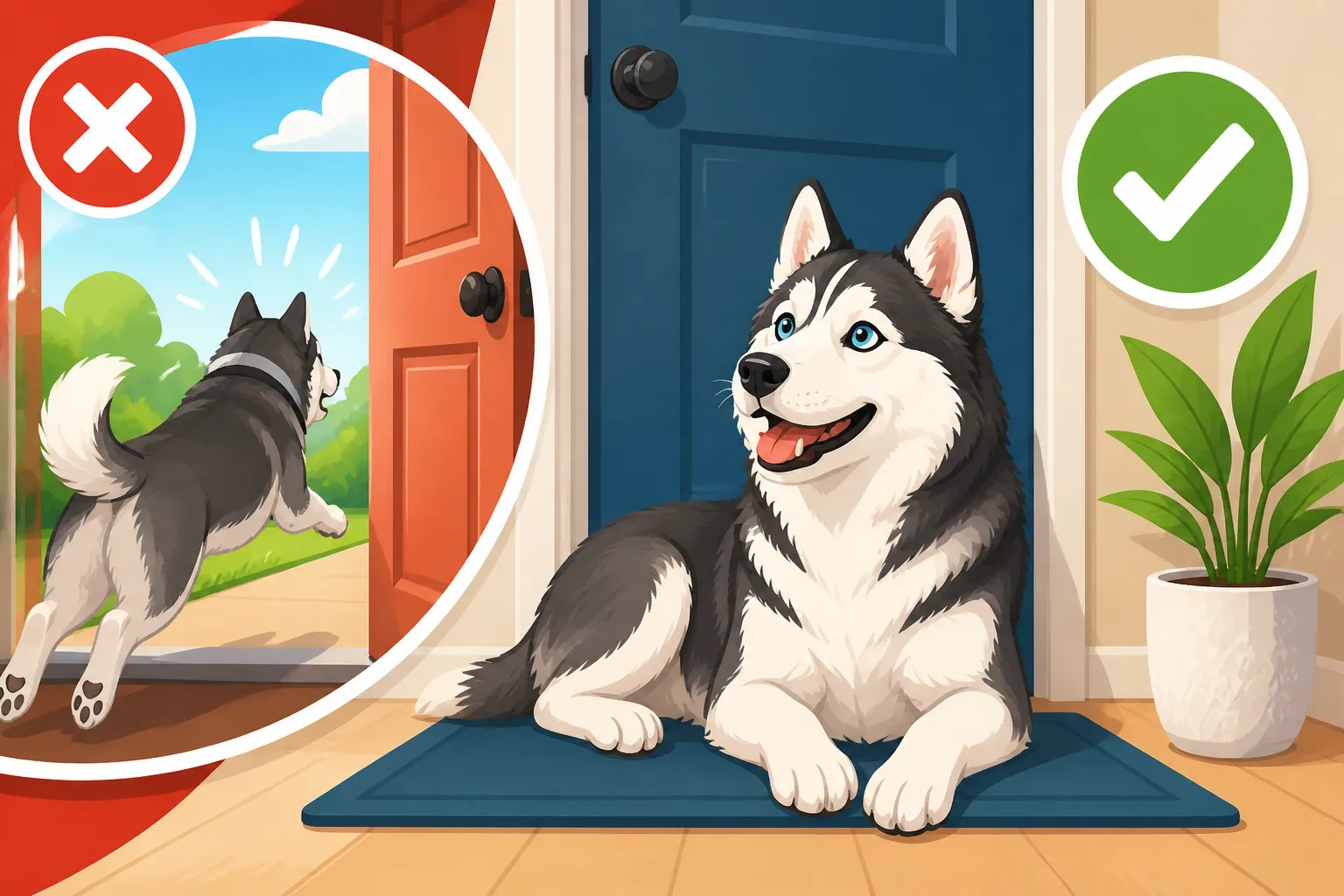
Once they understand "Wait" in a general sense, bring it to the door. Approach the door with your Husky on a leash. Before you touch the doorknob, ask them to "Wait." If they remain still, gently open the door a crack. If they surge forward, immediately close the door. No scolding, just a simple consequence: door closes, opportunity to leave vanishes. Only when they stay put with the door a crack open do you praise and reward them. Repeat this, gradually opening the door wider, until you can open it fully and they remain in their "Wait." This is a key step for Door Manners That Keep a Siberian Husky Inside.
This process can feel incredibly slow, and that’s okay. Remember, you’re working against powerful instincts. High-value treats are crucial here – think boiled chicken, cheese, or specialized training treats they only get for this exercise. The online courses from BAXTER & Bella can be incredibly helpful for breaking down complex behaviors like "Wait" into manageable steps, offering video tutorials and support that can guide you through the process, even with a stubborn Husky. They really understand how to make training stick.
Practicing Controlled Leashed Exits
Even with a strong "Wait" command, your Husky should always be leashed before exiting the house. This is non-negotiable. The leash is your ultimate safety line. Practice controlled exits where you clip the leash on inside the house, before even approaching the door. Ask for the "Wait" command, open the door, and then, only when they are calm and you give the release cue ("Okay!" or "Free!"), do you step out together.
Vary the routine. Sometimes you'll go for a walk, sometimes you'll step out to grab mail, sometimes you'll just open and close the door without going out. This prevents your Husky from associating the open door always with a fun walk and therefore getting overexcited. The goal is to make the doorway a neutral zone, not a portal to instant gratification. If your Husky pulls at the leash right as you exit, stop immediately. Only move forward when the leash is slack. This teaches them that pulling gets them nowhere, while walking politely gets them where they want to go. This attention to detail can help avoid situations where What Happens When a Siberian Husky Slips a Collar.
Make these practice sessions short, frequent, and positive. Celebrate every tiny success. If your Husky struggles, go back to a simpler step. Don't rush the process. A solid, reliable controlled exit can take weeks or even months of consistent practice, but it's an investment in your Husky's safety and your peace of mind. Consistency truly pays off, and it's a foundation for building a better The Recall a Siberian Husky Will Actually Give You.
Involving Everyone: Family, Friends, and Visitors
You can do all the training in the world, but if everyone else in the household (and any frequent visitors) isn’t on board, your efforts will be undermined. This is often the trickiest part of door manners. You need to establish a strict "door protocol" and ensure everyone follows it, every single time. This means no one opens the door without ensuring the Husky is secure, either by having them on a leash, behind a gate, or in their crate.
Educate your family members about the importance of the "Wait" command and how to properly execute it. Role-play scenarios with them. Explain the very real dangers of a Husky escaping, from traffic accidents to encounters with other animals. For friends and casual visitors, it's perfectly acceptable to instruct them: "Please don't open the door until I have [Husky's Name] secured." You can even put a sign on your door as a gentle reminder for guests to wait before entering.
For deliveries, have a strategy. Can you ask the delivery person to leave packages on the porch? Can you secure your Husky in another room before answering the door? Proactive planning eliminates last-minute stress. Remember, Huskies are master opportunists. One slip-up, one moment of laxness, can undo weeks of training. Consistency from every person who interacts with that door is absolutely critical. This is where Finding a Trainer Who Has Worked With Huskies can be invaluable, as they can help you create a household-wide training plan.
Here's a quick summary of key commands and their purpose at the door:
| Command | Purpose | When to Use It | Key to Success |
|---|---|---|---|
| Wait | Halt movement at the threshold | Before opening any exterior door | High-value rewards, consistency, gradual progression |
| Leash Up | Prepare for a controlled exit | Always before opening the door to go out | Make it part of the routine, positive association |
| Release Cue | Signal permission to cross the threshold | After "Wait" and ensuring safety, to allow exit | Clear, consistent word (e.g., "Okay," "Free") |
| Place/Crate | Move to a designated safe zone | During high-traffic times or when expecting visitors | Positive reinforcement, comfortable designated area |
Conclusion
Living with a Siberian Husky means embracing their unique blend of independence, intelligence, and an unshakeable desire for freedom. While their door-dashing instinct can be incredibly challenging, it's not insurmountable. By understanding their motivations, implementing robust physical barriers, and diligently training them with patience and consistency, you can significantly reduce the risk of an escape.
It's a continuous journey, not a destination. There will be moments of frustration, and perhaps even a near-miss or two, but every bit of effort you put into Siberian Huskies That Bolt Through Open Doors will pay off in your Husky's safety and your peace of mind. Stay vigilant, stay consistent, and always remember that a secure Husky is a happy Husky.
Disclaimer
This article is for general informational purposes only and does not constitute professional advice. Laws, prices and regulations vary by location and change over time. Consult a qualified professional for guidance on your specific situation.