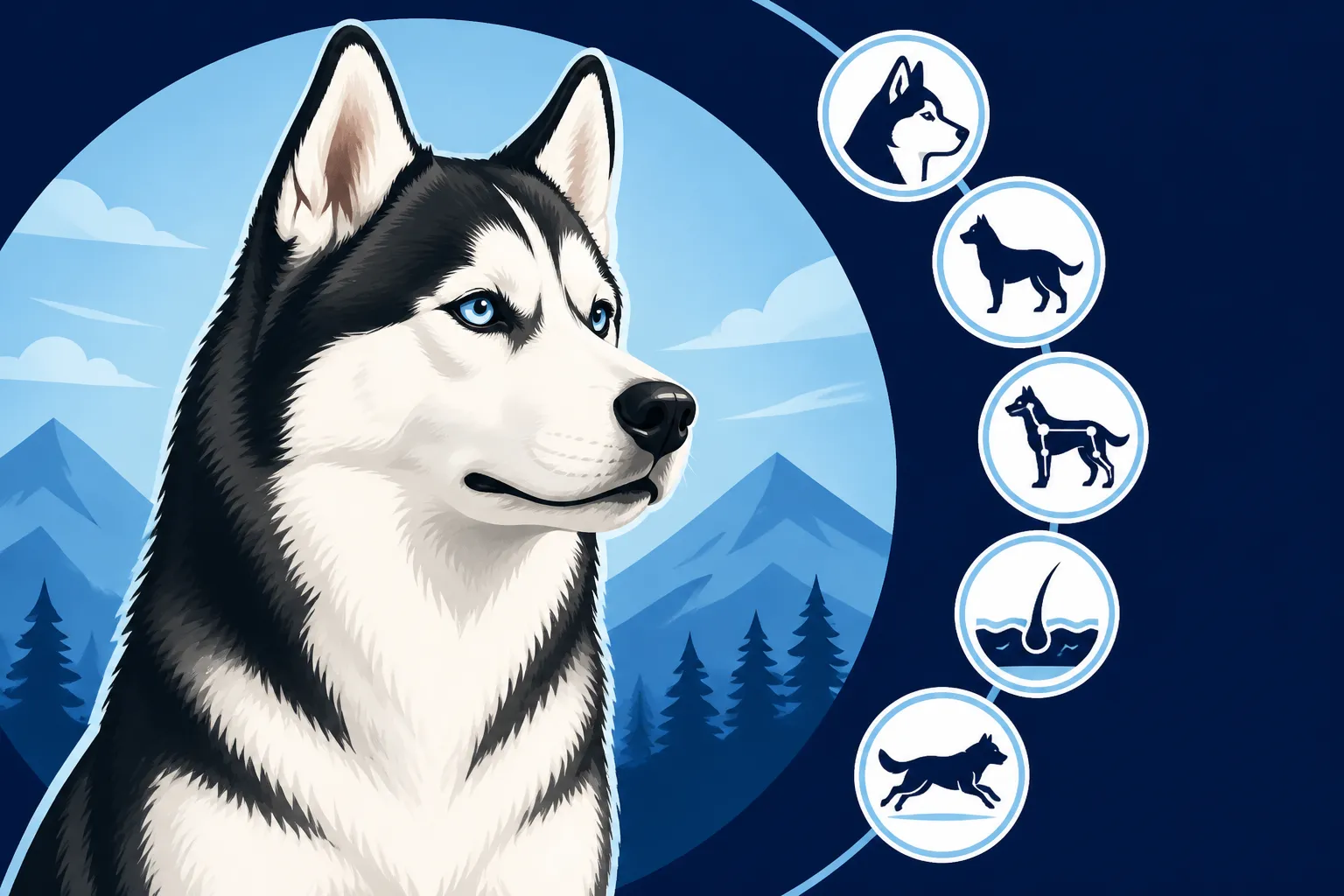
What the AKC Standard Asks of a Siberian Husky
It can be incredibly confusing to look at a breed standard for the first time. It's filled with technical jargon and specific measurements that often leave prospective owners, and even some seasoned ones, scratching their heads about what it really means for the dog in front of them. This guide aims to demystify the American Kennel Club (AKC) standard for the Siberian Husky, translating those often-dense descriptions into practical understanding for anyone who loves these amazing dogs.
Understanding the Essence of the Siberian Husky Standard
When we talk about the AKC standard for the Siberian Husky, we're delving into a document that serves as the blueprint for the breed. It describes the ideal Siberian Husky, not just in terms of physical appearance but also its characteristic gait and, crucially, its temperament. For anyone bringing a Husky into their home, or even just appreciating them from afar, understanding this standard offers a profound insight into what makes a Siberian Husky, well, a Siberian Husky.
Why Breed Standards Matter for Owners and Breeders
For breeders, the standard is their guiding star. It's what they strive for with every breeding decision, aiming to produce puppies that embody the breed's historical purpose and aesthetic. It's how they preserve the unique qualities that define the Siberian Husky, ensuring the breed continues to thrive as intended. Without such a standard, each breeder might go off in their own direction, leading to a fragmented and inconsistent breed population, losing those defining traits over time.
For owners, especially those new to the breed, the standard is equally invaluable. It helps you recognize what a well-bred Siberian Husky should look like, how it should move, and what its personality should generally be like. This knowledge is your best defense against unscrupulous breeders who might try to sell you a "Husky" that doesn't meet the health or temperament criteria, or worse, is a mix misrepresented as purebred. Knowing the standard empowers you to make informed decisions, whether you're looking for a companion or considering showing your dog. It's about more than just aesthetics; it's about the health, structure, and behavior that allow a Husky to live a full and appropriate life for its breed. It connects you directly to The Chukchi Origins of the Siberian Husky and why they were bred.
The Spirit Versus the Letter of the AKC Standard
It's easy to get bogged down in the exact measurements and precise angles described in the standard. But it's important to remember that these details are all in service of a larger picture: the spirit of the breed. The Siberian Husky was developed as a medium-sized working sled dog, capable of carrying a light load at a moderate speed over vast distances in frigid conditions. Every aspect of the standard, from its powerful, compact body to its dense double coat, contributes to this function. It's not about creating a "pretty" dog for show; it's about defining the characteristics that make it an efficient and enduring athlete of the snow.
So, while the standard might specify an eye shape or ear set, the underlying reason is how those features contribute to the dog's overall ability to perform its historical job. A Husky with incorrect structure, even if it looks superficially like the breed, might struggle with the stamina or movement required. The standard ensures that the Husky retains its athletic prowess and distinctive hardy character. It's about appreciating the functional beauty and understanding that form truly follows function in this breed. This dual perspective—understanding both the specific "letters" of the law and the "spirit" of the breed's purpose—is key to truly grasping what the AKC asks of a Siberian Husky.
Size, Proportion, and the Ideal Siberian Husky Frame
One of the first things the AKC standard addresses is the overall build of the Siberian Husky. It's not just about how tall or heavy a dog is, but how all those pieces fit together to create a harmonious and functional animal. Imagine a finely tuned machine; every part has a purpose and contributes to the machine's efficiency. The Husky's frame is no different, designed for endurance and speed over long distances.
The Numbers: Height, Weight, and Balance
The standard provides specific guidelines for height and weight, which can sometimes surprise people who are used to seeing larger, heavier northern breeds. For males, the ideal height range is 21 to 23.5 inches at the shoulder, with a weight range of 45 to 60 pounds. Females are slightly smaller, standing 20 to 22 inches and weighing between 35 and 50 pounds. These aren't arbitrary numbers; they reflect the breed's role as a medium-sized sled dog. A Husky that is too large or too heavy would be less efficient, burning more energy and sinking deeper into the snow. One that's too small might lack the necessary power.
It's a balance. You want a dog that feels substantial, but not cumbersome. The weight should be proportionate to the height, indicating a lean, athletic build rather than a stocky or obese one. This is crucial for their long-term health, as Siberian Husky Weight and Joint Health is a real concern, and carrying extra pounds puts unnecessary strain on their joints. When you run your hands over a well-conditioned Husky, you should be able to feel its ribs without them being overly prominent, and there should be a distinct waistline when viewed from above. This lean build is paramount for a dog whose historical job demanded incredible stamina and a high degree of physical fitness.
Proportion: The "Slightly Longer Than Tall" Rule
The AKC standard also specifies the proportion of the Siberian Husky, stating that the length of the body from the point of the shoulder to the rear-most projection of the rump should be slightly longer than the height from the ground to the top of the withers. This isn't a huge difference, usually just enough to give the dog a slightly rectangular, rather than square, appearance. This subtle difference in proportion is critical for the breed's signature gait and endurance.
A slightly longer body allows for greater reach and drive in their stride, making them more efficient movers. If a Husky were perfectly square, its movement might become choppy or less fluid, requiring more effort to cover the same ground. This proportion, combined with correct angulation (which we'll discuss later), enables the long, loping trot that is so characteristic of the breed. It also provides the necessary space for powerful muscle development in the loin and hindquarters, essential for propulsion. Understanding this proportion helps you evaluate a Husky's overall balance and how well its structure supports its intended function as a tireless sled dog.
Substance: Bone and Muscle Without Clumsiness
"Substance" in the breed standard refers to the overall bone structure and musculature of the dog. The Siberian Husky should have good bone, meaning their bones should be strong and well-developed, but not coarse or heavy like those of a Malamute. Think of it as a strong, athletic build rather than a bulky one. Their muscles should be firm and well-developed, clearly visible beneath their coat, indicating athleticism and power. However, this substance should never lead to clumsiness or a heavy appearance.
A Husky needs to be agile and able to move swiftly and gracefully across varied terrain, often through deep snow. Excessive bone or muscle mass would hinder this agility, making them less efficient and more prone to fatigue. The standard calls for a medium bone, neither too fine nor too heavy, and strong, well-toned muscles that blend smoothly into the overall frame. This ensures they have the strength for their work without sacrificing the speed and grace that defines their movement. When you see a well-conditioned Husky from a good line, they often look deceptively light until you realize the sheer power packed into their athletic form. It's this combination of solid build and agile grace that truly exemplifies the ideal Siberian Husky.
The Distinctive Head of a Siberian Husky
The head of a Siberian Husky is one of its most recognizable features, often giving the impression of intelligence, alertness, and a touch of mischief. The AKC standard meticulously describes The Siberian Husky Head, Ears and Tail, outlining the ideal shape and placement of each component to ensure it aligns with the breed's heritage and function. It’s more than just a pretty face; every aspect of the head contributes to the dog’s ability to interact with its environment and perform its duties.
Eyes: The Windows to the Husky Soul
The eyes are often the first thing people notice, and the standard is quite specific here. Siberian Huskies should have almond-shaped eyes, set moderately far apart and slightly oblique. This particular shape is not just for beauty; it offers protection against blowing snow and harsh winds, a direct nod to their working origins in arctic environments. The expression should be keen, but also friendly and sometimes even mischievous, reflecting the breed's Siberian Husky Temperament and What the Standard Says.
As for color, the standard allows for a wide range: brown, blue, or one of each (bi-eyed), which is known as heterochromia. Even parti-colored eyes (where one eye has patches of two different colors) are permissible. This incredible variety in eye color is one of the most striking features of the breed, and it’s important to note that blue eyes are absolutely not a fault in the Siberian Husky, contrary to what some might assume about other breeds. Siberian Husky Eye Colors and Heterochromia is a fascinating subject in itself, with all colors being equally acceptable under the standard, as none affect the dog's vision or working ability. What is important is that the eyes are clear, bright, and free from any discharge, indicating good health.
Ears: Alert and Perfectly Placed
A Siberian Husky's ears are one of its most defining characteristics: medium in size, triangular in shape, set high on the head, and carried stiffly erect. These aren’t floppy ears that collect snow or get frostbitten easily. Their placement and shape allow for excellent hearing in open, windy environments, helping them to navigate and stay alert during long treks. When a Husky is at attention, the ears should point straight up, with a slight arch at the back.
The tips of the ears should be slightly rounded, not sharply pointed, and covered with thick fur to provide insulation against the cold. The standard emphasizes that the ears should not be too large, nor too widely set, as this would detract from the breed's characteristic alert and watchful expression. Too small, and they might not be as effective in picking up distant sounds. The ear placement is also crucial to the overall balance of the head, framing the face in a way that is distinctly Siberian Husky. It’s a subtle yet important detail that truly contributes to the iconic look of the breed.
Skull, Muzzle, and Bite: Strength and Refinement
The skull of a Siberian Husky should be of medium size and in proportion to the body. It should be slightly rounded on top, tapering gradually from the widest part to the eyes. The muzzle should be of medium length, never appearing blunt or too pointed, and should be roughly equal in length from the stop (the indentation between the eyes) to the tip of the nose, and from the stop to the occiput (the back of the skull). This balance is key to the breed's refinement and strength.
A strong muzzle is necessary for a working dog, capable of holding objects and surviving in a harsh environment. The standard calls for a strong underjaw, and teeth should meet in a scissor bite, meaning the upper incisors slightly overlap the lower incisors when the mouth is closed. This bite is considered the most efficient for gripping and tearing food. A level bite (where the incisors meet edge-to-edge) or an undershot/overshot bite are considered faults, as they can compromise the dog’s ability to grasp and chew effectively, and can lead to dental problems over time. The nose can be black in gray, tan, or black dogs; liver in copper dogs; and may be flesh-colored (pink) in pure white dogs. A "snow nose," where the nose pigment fades with the seasons, is also perfectly acceptable and common. Every aspect of the skull, muzzle, and bite is about providing a robust yet refined structure suitable for a hardy working dog.
The Powerful and Agile Body Structure
The body of the Siberian Husky is a marvel of efficiency, built for sustained exertion and navigating challenging terrain. Every curve, every muscle group, is designed with a purpose: to allow the dog to pull a sled over long distances without quickly tiring. It's a testament to centuries of selective breeding by the Chukchi people who originally developed them.
Neck and Topline: Graceful and Strong
The neck of a Siberian Husky should be medium in length, gracefully arched, and carried proudly when the dog is standing. When moving at a trot, the neck extends forward, allowing the dog to lower its head slightly, which aids in balance and efficiency of movement. A neck that is too short would hinder this elegant extension, while one that is too long might lack the necessary strength to support the head during work.
The topline refers to the line of the back, from the withers (the highest point of the shoulders) to the tail. The standard specifies that the topline should be level and strong, extending in a straight line from the withers to the croup (the slight slope just before the tail). This level topline is crucial for efficient power transfer from the hindquarters to the forequarters, especially when pulling a load. A sloped or roached back would indicate structural weakness, leading to inefficient movement and potential fatigue or injury during prolonged activity. A strong, level topline ensures the Husky can maintain its powerful, steady stride for hours on end, fulfilling What a Siberian Husky Was Bred to Do.
Chest, Ribs, and Loin: Endurance in Action
The chest should be deep and strong, but not too broad. A deep chest provides ample room for the heart and lungs, which are essential for the incredible endurance required of a sled dog. However, if the chest is too broad, it can interfere with the foreleg movement, making the gait less efficient. The standard calls for moderately sprung ribs, meaning they should curve gently outwards from the spine and then flatten slightly along the sides. This allows for flexibility and ample lung capacity without creating a barrel-chested appearance that would hinder agility.
The loin, the area between the last rib and the pelvis, should be taut and lean, indicating strong muscles. It should be neither too long nor too short. A long loin can lead to a weak back, while an overly short loin can restrict flexibility and powerful hindquarter drive. The croup, the area from the pelvis to the tail set, should slope gracefully but not steeply. All these elements work together to form a body that is both powerful and flexible, capable of withstanding the rigors of long-distance hauling and quick, agile maneuvers when needed. This specific body architecture is a hallmark of the breed’s working capability.
The Tail: A "Brush" Not a "Sickle"
The Siberian Husky’s tail is another distinctive feature, often compared to a "fox brush." When the dog is relaxed, the tail should be carried low, sometimes curling slightly. When alert or excited, it typically curves gracefully over the back in a "sickle" shape. However, the standard specifies that it should not curl so tightly that it forms a complete circle or touches the back excessively. This is a subtle but important point; a tail that curls too tightly or lies flat against the back is considered a fault.
The tail should be well-furred, resembling a round brush, which serves a practical purpose in cold climates: a Husky will often curl up and tuck its tail over its nose for warmth, protecting its delicate mucous membranes from freezing temperatures. The hair on the tail should be of medium length, approximately the same length as the coat on the body, not feathered or overly long. This "brush" tail, with its correct carriage and furring, adds to the breed's arctic appearance and serves as a natural tool for survival and communication. It's a small detail, but vital to the overall silhouette and functional integrity of the Siberian Husky.
Forequarters and Hindquarters: Built for Effortless Movement
The structure of a Siberian Husky's legs and feet is paramount to its ability to perform its historical role as a sled dog. The AKC standard focuses heavily on these aspects because they directly dictate the dog's gait, endurance, and efficiency of movement. Every angle and bone placement is designed to facilitate that smooth, effortless trot over snow and ice.
Shoulders and Front Legs: Straight and True
The shoulders of a Siberian Husky should be well laid back, with the shoulder blade forming a distinct angle with the upper arm. This angulation is critical for allowing proper reach in the forelegs and cushioning the impact of movement. Imagine a dog with straight, upright shoulders; its stride would be short and jarring, leading to fatigue and potential injury. The standard emphasizes that the front legs, when viewed from the front, should be moderately spaced, parallel, and straight. This means no bowing in or out, which would compromise stability and lead to inefficient movement.
The elbows should be close to the body, neither turning out nor in. This ensures that the legs move cleanly forward and back, directly underneath the dog. The pasterns (the part of the leg just above the foot) should be strong and slightly sloping. This slight slope acts as a shock absorber, protecting the joints during movement, especially when pulling. Weak or straight pasterns are considered faults because they would make the dog prone to injury and reduce its endurance. Strong, straight front legs are the foundation for the Husky's powerful forward propulsion, allowing it to maintain speed and efficiency over long distances.
Paws: Compact, Oval, and Well-Furred
The Siberian Husky's feet are another marvel of arctic adaptation. The standard describes them as oval in shape, not round, and medium in size. They should be compact and well-knuckled, meaning the toes are held tightly together. This tight formation helps prevent snow from accumulating between the pads and protects the toes from frostbite and injury. The pads themselves should be tough and thick, providing traction and insulation.
A defining characteristic is the dense fur between the toes and around the pads. This extra fur acts like natural snowshoes, providing insulation and preventing ice buildup, which can be incredibly painful and debilitating for a working dog. Imagine a dog trying to run with ice balls stuck between its toes – it wouldn't last long! Dewclaws are usually removed in puppies, though the standard doesn't specifically mandate this for showing; it's more common practice for working dogs to prevent injury. Overall, the Husky’s paws are perfectly engineered for stability, traction, and protection in extreme cold, showcasing the breed's functional design. You might even find yourself looking for paw balms and protective gear for your Husky from retailers like Chewy to ensure their paws stay healthy and strong, especially if they are active in varied terrains.
Angulation and Drive in the Hindquarters
Just like the forequarters, the hindquarters of a Siberian Husky are carefully described in the standard to ensure maximum efficiency and power. The angulation of the stifle (knee joint) should be moderate, and the hocks (ankle joints) should be well-defined and set low to the ground. When viewed from the rear, the hind legs should be parallel and moderately spaced, moving in line with the front legs. This proper angulation provides the powerful drive needed for propulsion, propelling the dog forward with each stride.
Too much angulation can lead to a loss of efficiency and stability, while too little angulation can result in a short, choppy gait that lacks power. The muscling in the hindquarters should be firm and well-developed, particularly across the thighs, indicating strength and endurance. The feet of the hindquarters are identical to the forequarters – compact, oval, and well-furred. This symmetrical and balanced structure allows the Siberian Husky to distribute its weight evenly and apply maximum force to the ground, translating into the incredibly efficient, smooth, and tireless gait for which the breed is famous. Proper hindquarter construction is a key factor in Siberian Husky Hips and Why the Rate Is Low compared to some other breeds, although reputable breeders still prioritize health screenings.
The Iconic Siberian Husky Coat and Its Colors
Perhaps no feature of the Siberian Husky is more iconic than its magnificent double coat. This coat is not merely decorative; it's a finely tuned piece of natural engineering, perfectly adapted to protect the dog in the harshest arctic conditions. The AKC standard describes it in detail, distinguishing between acceptable and unacceptable variations, all based on functionality.
The Double Coat: Nature's Perfect Insulation
The Siberian Husky possesses a characteristic double coat, consisting of two distinct layers. The undercoat is soft, dense, and typically woolly, designed to provide incredible insulation against cold temperatures. This layer traps warm air close to the dog's body, acting as a natural thermal barrier. The outer coat, or guard coat, is made up of medium-length, straight hairs that lie smoothly, but are never so long as to obscure the clean-cut outline of the dog. These guard hairs are water-repellent, shedding snow and moisture, and also protect the undercoat from getting wet.
The standard explicitly states that the coat should never be harsh or wiry, nor should it be so long that it appears shaggy or "wooly." A correctly textured coat allows for heat retention in winter and provides protection from the sun's rays in summer, reflecting heat away from the body. It’s a common misconception that Huskies are uncomfortable in warmer climates due to their coat; a properly functioning double coat actually helps regulate their body temperature year-round. This is why you should Never Shave a Siberian Husky, as it destroys this natural insulation system, making them less comfortable in heat and prone to sunburn. The density and texture are far more important than the length for its protective qualities.
Accepted Coat Colors and Markings
One of the most appealing aspects of the Siberian Husky is the sheer variety of coat colors and markings it presents. The AKC standard is quite liberal here, stating that "all colors from black to pure white are allowed." This includes a spectrum of grays (silver, wolf gray, medium gray, dark gray), sables, reds (light red, copper, dark red), and black and white. It's a common misunderstanding that certain colors are rarer or more valuable; in the eyes of the standard, all colors are equally acceptable.
Beyond the base colors, Huskies can exhibit a wide array of striking markings, especially on the head. These can include dramatic facial masks, "goggles" around the eyes, or streaks of color that create unique patterns. Some Huskies have "agouti" coloring, which is a wild-type pattern where each individual hair has bands of different colors, giving a grizzled appearance. Siberian Husky Coat Colors and Markings are part of what makes each dog unique and beautiful. The standard doesn't favor one pattern over another, celebrating the breed's diverse aesthetic. The goal is a healthy, structurally sound dog, regardless of its beautiful coat pattern.
Faulted Coats: The "Wooly" Question
While the standard allows for a wide range of colors, it is very specific about coat texture and length. The most common coat fault mentioned is the "wooly" coat. A wooly coat is characterized by excessively long, soft, and often shaggy hair, particularly on the body and ears. While visually striking to some, a wooly coat is a serious fault in the breed standard because it compromises the coat's primary function: protection and insulation.
The long, soft hairs of a wooly coat tend to absorb moisture, mat easily, and fail to provide the same level of water repellency and insulation as a correct double coat. In severe cold, a wet wooly coat could actually lead to hypothermia, rather than preventing it. Furthermore, it often lacks the protective guard hairs that shed snow and ice. The standard specifies that the coat should be of "medium length," and a wooly coat clearly exceeds this. Breeders who prioritize the health and working ability of their Huskies will actively avoid producing wooly coats, even if they sometimes fetch a higher price from uneducated buyers. Understanding the importance of a correct coat type is vital for appreciating the functional design of the Siberian Husky. For owners dealing with the incredible shedding of a correct double coat, especially during Siberian Husky Coat Blow and the Six Weeks It Lasts, resources from places like Chewy for high-quality deshedding tools can be a lifesaver.
Gait and Temperament: The Moving Picture and Inner Character
While appearance is important, the AKC standard for the Siberian Husky places immense emphasis on gait and temperament. These aspects are often considered the true heart of the breed, as they speak to its functionality and personality, which are inseparable from its historical role as a working sled dog. A Husky that looks perfect but can't move correctly or has an inappropriate temperament is not a true representation of the breed.
The Effortless, Smooth Gait
The gait of a Siberian Husky is described as "smooth and seemingly effortless." When moving at a trot, the gait should be free and agile, exhibiting good reach in the forequarters and good drive in the hindquarters. The dog should appear to glide over the ground, covering maximum distance with minimum effort. This efficiency is paramount for a dog bred to pull loads for many miles without tiring. From the front, the legs should move parallel, and as speed increases, the legs will converge towards a single centerline beneath the body – this is known as a "single track."
Any signs of clumsiness, a short or choppy stride, crabbing (moving with the body angled), or paddling (feet swinging outwards) are considered faults. These indicate structural deficiencies that would compromise the dog's endurance and working ability. The standard specifies that the Husky should not exhibit a "choppy, stilted, or rolling gait." Observing a Siberian Husky move correctly is truly a beautiful sight, showcasing the breed's incredible athletic design and how perfectly its structure supports its function. This characteristic gait is what enables a Husky to work tirelessly over vast, snowy expanses.
The Husky Temperament: Friendly, Mischievous, and Independent
Beyond its physical attributes, the temperament of a Siberian Husky is a defining characteristic outlined in the AKC standard. The standard describes the ideal Husky as "friendly and gentle," but also "alert and outgoing." They are not typically aggressive or overly suspicious of strangers, which makes them poor guard dogs. Instead, they are known for their sociable nature and playful demeanor. This comes from their history of living and working in large packs, and often sharing close quarters with their Chukchi human companions.
However, this doesn't mean they are blindly obedient. The standard also notes their "independent" spirit. Huskies are highly intelligent but can be notoriously stubborn and possess a mischievous streak. This independence stems from their need to make quick decisions on the sledding trail, sometimes without direct command, in harsh conditions. While they are loyal to their families, they are not typically "one-person" dogs and often distribute their affection widely. They thrive on companionship, whether from humans or other dogs, and do not do well when left alone for long periods without mental and physical stimulation. This can lead to destructive behaviors if their needs aren't met. Understanding Siberian Husky Temperament and What the Standard Says is critical for any potential owner to ensure a harmonious life with this unique and spirited breed.
Understanding Faults and Disqualifications
The AKC standard doesn't just describe the ideal; it also lists faults and disqualifications. Faults are deviations from the ideal that detract from the dog's overall quality and suitability for its purpose, but do not prevent it from being registered or bred (though serious faults should always be avoided in breeding). Examples of common faults include a coarse or heavy head, a long or wooly coat, weak pasterns, or an incorrect bite. These might impact a dog's performance in the show ring or even its long-term health and functional ability.
Disqualifications, on the other hand, are serious deviations that render a dog ineligible for conformation showing and usually indicate a fundamental departure from the breed type. For the Siberian Husky, specific disqualifications include a height exceeding the stated limits, as well as an aggressive or overly shy temperament. The latter is particularly important; a Husky that is overly aggressive or extremely timid would be completely unsuited for its historical role within a pack or with humans. Understanding Faults and Disqualifications in a Siberian Husky helps reinforce the importance of breeding for health, correct structure, and stable temperament, ensuring the integrity and future well-being of the breed. It underscores that the standard is a tool for preserving not just looks, but the very essence of the Siberian Husky.
| Feature | Ideal AKC Standard Description | Common Misconceptions/Variations |
|---|---|---|
| Size | Males: 21-23.5 inches, 45-60 lbs; Females: 20-22 inches, 35-50 lbs. Medium bone, not heavy. | Larger, heavier Huskies are more desirable or powerful. "Giant" Huskies exist (often mixes or poorly bred). |
| Proportion | Body slightly longer than tall (point of shoulder to rump slightly longer than height at withers). | Square-bodied Huskies are fine. Longer backs are weak. |
| Eyes | Almond-shaped, moderately spaced, slightly oblique. Brown, blue, or one of each. Keen, friendly expression. | Blue eyes are rare/superior/faulted. Round eyes are acceptable. Eye color indicates health problems. |
| Ears | Medium size, triangular, set high, carried stiffly erect, well-furred, slightly rounded tips. | Large, widely set, or overly pointed ears are fine. Ears flop down often. |
| Muzzle/Bite | Medium length, tapering to nose. Equal length from stop to nose and stop to occiput. Scissor bite. | Any bite is fine. A short, blunt muzzle (like a Pitbull) is acceptable. |
| Topline | Level and strong from withers to croup. | A slightly sloped or roached back is normal. |
| Tail | "Fox brush" tail. Carried low when relaxed, curved sickle over back when alert (not tightly curled or touching back). | Tail carried in a tight curl against the back is preferred. Thin, sparsely furred tail is acceptable. |
| Coat | Double coat: dense, soft undercoat; medium length, straight guard hairs (not harsh, wiry, or wooly). Sheds snow/water. | Shaving the coat in summer is beneficial. "Wooly" coats are a desirable, rare variant. Coat length can vary significantly. |
| Gait | Smooth, effortless, free, and agile trot. Good reach and drive, single-tracking at speed. | Choppy, stilted, or heavy movement is acceptable for a working dog. |
| Temperament | Friendly, gentle, alert, outgoing, mischievous, independent. Not aggressive, overly suspicious, or timid. | Guard dog instincts are strong. Easily trained and highly obedient. |
Conclusion
The AKC standard for the Siberian Husky is much more than just a beauty contest rulebook. It's a comprehensive description of a dog bred for a very specific and demanding purpose: to pull light loads at moderate speeds over vast, frozen landscapes. Every detail, from the length of its muzzle to the angulation of its hindquarters and the texture of its coat, is designed to enhance its efficiency, endurance, and survival in extreme conditions.
For those of us who share our lives with these incredible animals, understanding the standard helps us appreciate the thoughtful design behind our furry companions. It encourages us to support responsible breeders who prioritize health, temperament, and structural integrity, rather than just novel colors or exaggerated features. It grounds our expectations in realism, acknowledging the independent, sometimes mischievous, yet always friendly spirit that truly defines the breed. By looking beyond the superficial, we can see the Siberian Husky as the magnificent, functional athlete it was always intended to be, a testament to the enduring bond between humans and their dogs.
Disclaimer
This article is for general informational purposes only and does not constitute professional advice. Laws, prices and regulations vary by location and change over time. Consult a qualified professional for guidance on your specific situation.