Whether Siberian Huskies Are Actually Intelligent
Many new Siberian Husky owners often feel like they've adopted a charming, furry enigma. They might hear stories of their dogs outsmarting fences or opening latches, yet struggle to get them to reliably come when called. This common disconnect leads many to wonder: are Siberian Huskies truly intelligent, or are they just stubborn and independent? This guide aims to clear up the confusion, delving into the unique intelligence of the Siberian Husky and offering insights into how their ancient instincts shape their behavior, often in ways that defy conventional notions of dog smarts.
Unpacking the Myth of the "Dumb Husky"
Let's get one thing straight from the start: Siberian Huskies are not "dumb." Far from it. The perception often comes from their performance in traditional obedience settings, where they might seem less eager to please than, say, a Golden Retriever or a Border Collie. But this isn't a lack of brainpower; it's a difference in how their intelligence manifests and what they were historically bred to do.
Defining Intelligence in Canines Beyond Obedience
When we talk about canine intelligence, it's rarely a single, monolithic concept. Think of it more like a spectrum with different facets:
- Adaptive Intelligence: This is a dog's ability to learn from experience and solve problems on their own. It's about figuring things out.
- Working and Obedience Intelligence: This measures how well a dog learns and performs tasks and commands given by humans. This is what most people think of when they gauge a dog's "smartness."
- Instinctual Intelligence: This relates to a dog's inherent abilities based on their breed's purpose – herding, retrieving, guarding, or in the Husky's case, pulling a sled and surviving in harsh environments.
Siberian Huskies often score lower in working and obedience intelligence simply because their instincts don't naturally lean towards immediate human compliance. They weren't bred to heel perfectly or perform complex tricks on command for their survival. Their historical role demanded independent thinking and resilience, not constant deference to a handler. This independent streak is often mislabeled as stubbornness, but it's really a testament to their unique mental makeup. For more on this, check out Why Siberian Huskies Look Stubborn Rather Than Slow.
The Husky's Instinctual Brilliance
Where Huskies truly shine is in their adaptive and instinctual intelligence. These are dogs who, for generations, were relied upon by the Chukchi people not just for pulling, but for their ability to navigate treacherous terrain, find their way home, and make independent decisions that could mean the difference between life and death in a blizzard.
Consider the "escape artist" reputation of the Siberian Husky. This isn't naughtiness; it's pure, unadulterated problem-solving. A Husky that figures out how to open a gate latch, scale a fence, or dig under a barrier isn't being disobedient; it's applying its inherent intelligence to achieve a goal – usually, to explore or run, driven by their deep-seated roaming instinct. They observe, they experiment, and they remember what works. This same ingenuity would have been vital for their ancestors to find food or shelter when separated from the pack. It's why they can be so challenging to contain, and why Stopping a Siberian Husky From Escaping the Yard is such a common topic among owners.
Their high prey drive is another facet of their instinctual brilliance. While it can be frustrating for owners with small pets or livestock, it demonstrates keen observational skills, lightning-fast reflexes, and an innate understanding of how to stalk and pursue. This isn't something to "train out" entirely; it's a deep-seated part of their intelligent design, reminding us that they are indeed still very close to their primitive roots.
The Independent Thinker: Why Huskies Don't Always Listen
The biggest hurdle for many Husky owners, and the source of most "stubborn" accusations, is the breed's fiercely independent nature. This isn't a flaw; it's a defining characteristic that stems directly from their historical purpose.
Bred for Independence, Not Compliance
Imagine a team of sled dogs in the vast, unforgiving Siberian wilderness. Their musher is bundled against the elements, often unable to give precise, constant commands. Those dogs needed to think for themselves. They needed to navigate, avoid hazards, and maintain their pace, sometimes for days, without micromanagement. This is the genetic blueprint of your modern Siberian Husky.
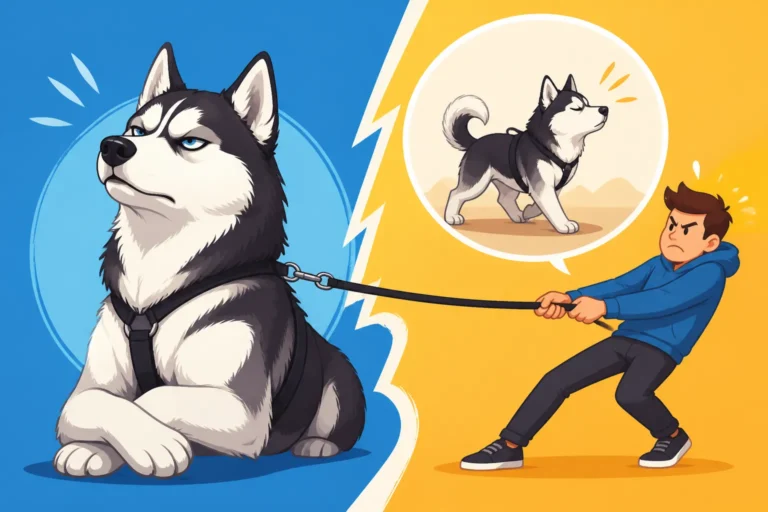
They were not bred to be eager-to-please, biddable companions like a Labrador Retriever, whose job often involved working closely with a hunter and responding instantly to cues. Instead, Huskies were bred to be partners who could make smart, independent decisions. This means that while they absolutely can learn commands, they often process them with a silent question: "What's in it for me?" or "Is this really the best course of action right now?" This unique working relationship required trust and mutual respect, rather than absolute dominance and submission. Their intelligence is geared towards survival and efficiency in a team setting, where each dog plays a crucial, self-directed role.
The Art of Selective Hearing
If you've ever called your Husky from across the park, watched them make eye contact, and then deliberately turn and sprint in the opposite direction, you've experienced their "selective hearing." It’s not that they didn't hear you or didn't understand the word "come." It's that, in that moment, the thrill of the chase, the scent of a distant squirrel, or the sheer joy of running freely outweighed the perceived reward of returning to you. This is the Why a Siberian Husky Cannot Be Trusted Off Leash reality for most owners.
This selective hearing is often interpreted as a lack of intelligence, but it's quite the opposite. It shows a dog capable of complex decision-making, weighing options, and prioritizing based on their desires. They are intelligent enough to understand the command, intelligent enough to understand the potential consequences (or lack thereof), and intelligent enough to choose what brings them the most immediate satisfaction. This makes training a Husky a unique challenge, requiring immense patience, creativity, and a deep understanding of their motivations. They are not mindless followers; they are intelligent beings with their own agenda, which sometimes, perfectly legitimately, conflicts with ours.
Harnessing Husky Brainpower: Training and Engagement
Given their unique blend of intelligence and independence, training a Siberian Husky requires a different approach than many other breeds. It's less about breaking their will and more about channeling their incredible mental and physical capabilities.
Tailoring Training to the Husky Mind
Forget harsh corrections or repetitive drills; a Husky will quickly become bored or simply shut down. The key is to make training a game, exciting and rewarding.
- Short, Engaging Sessions: Huskies have short attention spans for anything they deem repetitive or uninteresting. Keep training sessions brief (5-10 minutes), upbeat, and varied. End on a high note, even if it's just for one successful command.
- High-Value Rewards: Those kibble pieces you use for your other dog? Probably not going to cut it for a Husky. They need something truly motivating – slices of cooked chicken, cheese, or specialized training treats from a place like Chewy. The reward needs to consistently outweigh whatever distraction is competing for their attention. For more ideas on what motivates them, check out Food Rewards a Siberian Husky Will Work For.
- Consistency is Crucial: While they're independent, Huskies thrive on routine and clear expectations. Everyone in the household needs to use the same commands and enforce the same rules consistently.
- Build a Strong Relationship: Huskies respond best to people they respect and trust. Spend quality time with your Husky, engage in activities they love, and build a bond based on positive experiences. This relationship forms the foundation for all successful training.
Mental Stimulation Beyond Formal Commands
Formal obedience is just one small part of what satisfies a Husky's intelligent mind. They need outlets for their problem-solving skills and their innate drives.
- Puzzle Toys: These are fantastic for mental enrichment. Fill them with a portion of their meal or high-value treats and watch your Husky strategize to get the goodies out. Brands available at Chewy offer a wide array of options, from slow feeders to complex treat-dispensing toys, perfect for keeping their minds busy. Puzzle Feeders a Siberian Husky Cannot Beat can be a real game-changer.
- Scent Work: Huskies have incredible noses. Hide treats around the house or yard and let them use their natural sniffing abilities to find them. This engages their brain in a way that's deeply satisfying to them.
- Harness Sports: Their entire existence was built around pulling. Activities like Canicross (running with your dog pulling you), bikejoring (biking with your dog pulling), or even just pulling a cart can be incredibly fulfilling. It taps into their genetic purpose and provides immense physical and mental stimulation. Discover more about this in Canicross and Bikejoring With a Siberian Husky.
- Rotate Toys: Keep their environment fresh and interesting by rotating their toys regularly. A toy that's been put away for a few weeks feels new and exciting when it reappears. This helps keep Keeping a Siberian Husky Interested in Training and play.
Setting Up for Success in the Home
Managing a Husky's intelligence often means setting up their environment to prevent them from "outsmarting" you or getting into trouble.
- Secure Containment: This cannot be stressed enough. Their adaptive intelligence makes them incredible escape artists. A standard fence often isn't enough. Consider a six-foot fence, potentially with an L-footer to prevent digging out and coyote rollers to prevent climbing over. Six-Foot Fences and the Siberian Husky That Climbs is essential reading for any Husky owner.
- Crate Training: A well-crate-trained Husky views their crate as a safe den. It's not a punishment. It's a place where they can relax and be contained safely when you can't directly supervise them. Choosing a durable crate is vital, as a smart Husky will exploit any weakness. You'll want one of the Crates a Siberian Husky Cannot Break Out Of.
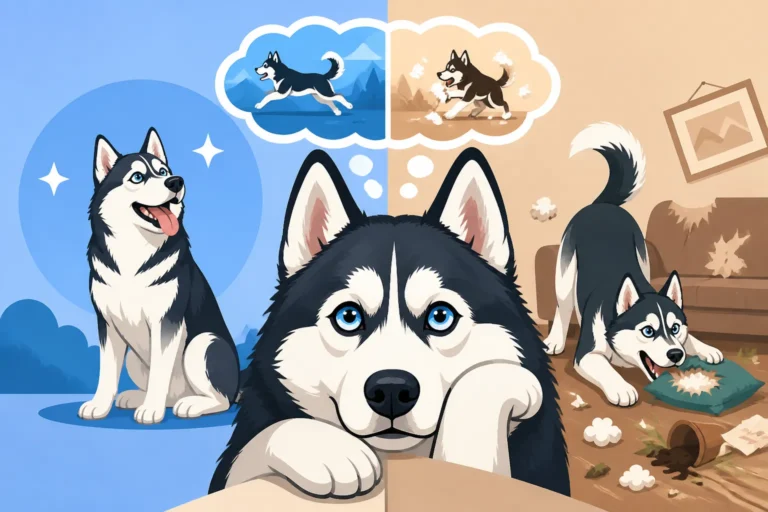
- Preventing Boredom: A bored Husky is a destructive Husky. Their intelligent minds need constant engagement. If left alone with nothing to do, they'll invent their own "games," which often involve chewing through furniture, digging up the yard, or trying to escape. Toys, puzzle feeders, and plenty of exercise are your best defense. Chewy offers a vast selection of durable toys to stand up to even the most determined Husky chewer.
Here's a quick look at how Husky intelligence stacks up against common perceptions:
| Trait | Common Perception (Misinterpretation) | Reality (Husky Intelligence) |
|---|---|---|
| Obedience | Stubborn, disobedient | Independent decision-maker; prioritizes self-interest or instinct |
| Escaping | Naughty, destructive | Adaptive problem-solver; uses ingenuity to achieve goals |
| Training Pace | Slow learner | Learns quickly but easily bored; requires high motivation |
| Interaction | Aloof, not affectionate | Forms deep bonds on their own terms; expresses love uniquely |
| Prey Drive | Unmanageable, wild | Highly attuned hunter; strong instinctual intelligence |
The Emotional Intelligence of a Siberian Husky
Beyond their cunning problem-solving and independent thought, Siberian Huskies also possess a nuanced emotional intelligence that often goes unrecognized. They might not be as overtly expressive as some breeds, but they are deeply sensitive to their environment and the people within it.
Reading Their People and Environment
Huskies are masters at reading human emotions, even if they don't always choose to directly console you in the way a Golden Retriever might. They often react to changes in household dynamics, stress levels, or even just your daily routine. A Husky might become more restless if they sense tension, or more demanding of attention if they feel neglected. They pick up on subtle cues, tone of voice, and body language, allowing them to anticipate events or understand your mood, even if they respond in their own unique, sometimes frustrating, way.
For instance, a Husky might seem to "know" when it's almost time for a walk, even before you reach for the leash, based on your subtle preparations. They can also be surprisingly empathetic, sometimes nudging a sad owner or offering a quiet presence, showing a deep understanding of emotional states. It's just not always the Hollywood version of dog comfort.
Unique Communication Styles
A significant part of a Husky's intelligence lies in their distinct communication. They are not typically big barkers, but they are renowned for their "talking" – a medley of howls, yips, grumbles, and "woo-woos" that expresses a wide range of emotions and desires. This vocalization is a sophisticated form of communication that owners learn to interpret over time. Why Your Siberian Husky Howls and Talks explores this fascinating aspect of their personality in depth. They might "argue" with you when they don't want to go inside, express joy with a series of excited yips, or communicate boredom with a plaintive howl. Understanding these vocalizations is key to unlocking a deeper bond with your Husky and appreciating their unique intelligence.
Their body language is also rich with subtle cues. From the position of their ears to the carriage of their tail, a Husky constantly communicates. Learning to read these signals helps you understand their intent, whether they're feeling playful, cautious, or simply ready for a nap. This emotional awareness, combined with their cognitive abilities, paints a picture of a truly intelligent, albeit unconventional, canine companion.
Disclaimer
This article is for general informational purposes only and does not constitute professional advice. Laws, prices and regulations vary by location and change over time. Consult a qualified professional for guidance on your specific situation.